In this article
- TL;DR: Building Your Content Marketing Strategy
- What Is a Content Marketing Strategy?
- Why You Need a Content Marketing Strategy in 2026
- Step 1: Set Clear Goals and Objectives
- Step 2: Identify and Understand Your Target Audience
- Conduct Audience Research
- Create Detailed Buyer Personas
- Step 3: Audit Your Existing Content
- Step 4: Establish Your Content Pillars
- Step 5: Choose Content Formats and Types
- Match Formats to Audience Preferences
- Content for Each Funnel Stage
- Step 6: Create a Content Calendar
- Step 7: Develop Your Content Creation Process
- Establish Content Workflows
- Maintain Quality at Scale
- Step 8: Plan Your Distribution Strategy
- Choose the Right Channels
- Distribution Tactics That Work
- Step 9: Optimize for SEO and AI Visibility
- Keyword Research and Topic Clustering
- On-Page SEO Best Practices
- Building Authority
- Step 10: Measure, Analyze, and Optimize
- Track the Right Metrics
- Use Analytics Tools Effectively
- Turn Data Into Action
- Advanced Strategy Considerations for 2026
- Prepare for AI-Powered Search
- Build Owned Audiences
- Focus on Authenticity and Human Connection
- Common Content Strategy Mistakes to Avoid
- Content Strategy Templates and Resources
- Conclusion
TL;DR: Building Your Content Marketing Strategy
- Building an effective content marketing strategy requires 10 essential steps:
- Set SMART goals aligned with business objectives
- Identify your target audience through detailed buyer personas
- Audit existing content to find gaps and top performers
- Establish 3-5 core content pillars that showcase expertise
- Choose content formats matching audience preferences (video accounts for 82% of internet traffic in 2026)
- Create an editorial calendar for consistent publishing
- Develop streamlined content workflows
- Plan multi-channel distribution across owned, earned, and paid channels
- Optimize for SEO and AI visibility (30% of searches now use voice),
- Measure performance using engagement, conversion, and ROI metrics to continuously improve.
- Companies with documented strategies are X3 more likely to report success than those winging it, making a structured approach essential for achieving measurable business results in today’s competitive landscape.
What Is a Content Marketing Strategy?
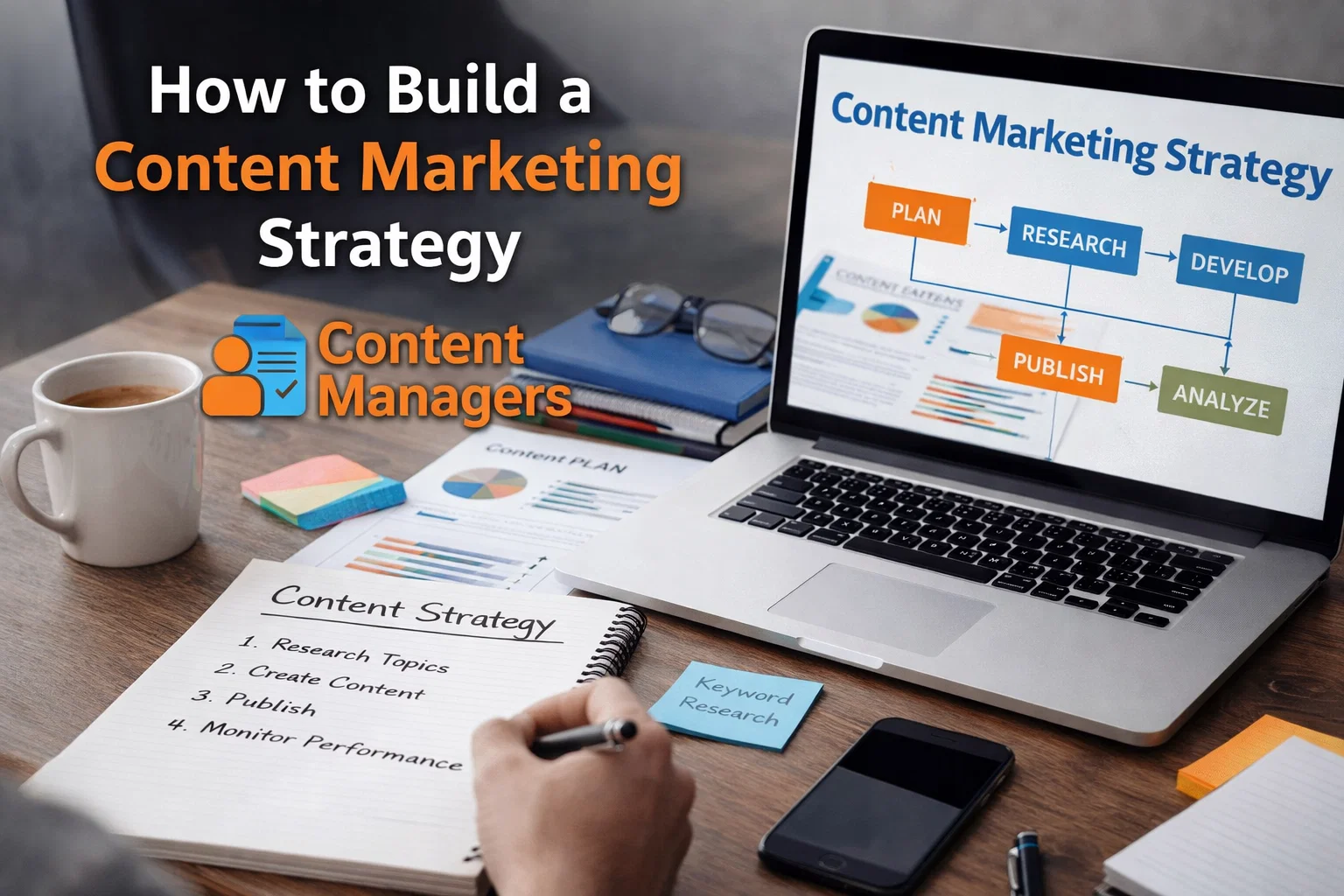
A content marketing strategy is a comprehensive plan that guides how you create, publish, and manage content to achieve specific business goals. Unlike random content creation based on inspiration or trending topics, a strategy provides clear direction on what content to produce, who it serves, where to distribute it, and how to measure success.
This documented approach covers everything from audience research and topic selection to creation workflows and performance tracking. The difference between having a strategy and simply creating content shows dramatically in results. Organizations with documented content marketing strategies are 3 times more likely to report success compared to those without formal plans.
In 2026, content strategy has evolved beyond basic blogging to encompass video marketing, AI-optimized content, voice search readiness, and first-party data collection. Your strategy needs to address how people discover content through AI overviews, how algorithms prioritize authentic human connection over polished corporate messaging, and how privacy changes affect audience tracking and measurement.
Why You Need a Content Marketing Strategy in 2026
The content landscape has become too competitive for trial-and-error approaches to succeed. Over 90% of B2B marketers use content marketing, and audiences encounter thousands of content pieces daily. Without a strategy directing your efforts toward clear objectives with measurable outcomes, your content gets lost in the noise regardless of quality.
A documented strategy provides several critical advantages. First, it aligns your entire team around shared goals and eliminates conflicting priorities between departments. Second, it ensures consistency in messaging, voice, and publishing frequency, which builds audience trust over time. Third, it enables accurate performance measurement by establishing baseline metrics and clear success criteria before content creation begins.
The business case for strategic content marketing proves itself through ROI data. Content marketing costs 62% less than traditional marketing while generating approximately three times more leads. Companies publishing consistent, strategic content see 7.8 times more site traffic than competitors who publish sporadically without clear direction.
In 2026 specifically, strategic planning matters more because of algorithmic changes prioritizing expertise and authenticity, the rise of AI-generated search results requiring optimization beyond traditional SEO, and privacy regulations limiting tracking capabilities. These shifts make inefficient content creation financially unsustainable.
Step 1: Set Clear Goals and Objectives
Your content strategy begins with defining what success looks like in measurable terms. Generic goals like “increase brand awareness” or “generate more leads” provide no clear target for your efforts. Effective goals follow the SMART framework: specific, measurable, achievable, relevant to business priorities, and time-bound with clear deadlines.
Common content marketing objectives include building brand awareness among new audiences, generating qualified leads for sales teams, improving customer engagement and retention, establishing thought leadership in your industry, supporting customer education and onboarding, and driving direct revenue through content-influenced conversions.
Each goal requires different content approaches and success metrics. Brand awareness prioritizes reach, impressions, and share of voice. Lead generation focuses on conversion rates, lead quality scores, and cost per acquisition. Customer retention measures engagement time, return visit rates, and product adoption metrics.
Align your content goals directly with broader business objectives rather than treating content as an isolated marketing activity. If company priorities include entering a new market segment, your content goals should specify reaching that audience with targeted topics. If reducing customer churn ranks as a top priority, content goals should address engagement rates among existing customers and support ticket deflection through educational resources.
Define 3-5 primary KPIs that directly connect content performance to business outcomes. Track metrics like organic traffic growth percentages, conversion rates from content to qualified leads, customer acquisition cost attributed to content channels, average engagement time on key content pieces, and return on investment calculated as revenue influenced divided by content costs.
Step 2: Identify and Understand Your Target Audience
Conduct Audience Research
Effective content strategy starts with deep understanding of who you serve and what they need. Begin audience research by analyzing existing customer data from your CRM, support tickets, sales calls, and product usage patterns. This first-party data reveals actual behavior rather than assumptions about what audiences might want.
Conduct direct audience research through surveys asking customers about their biggest challenges, preferred content formats, trusted information sources, and decision-making processes. Schedule one-on-one interviews with 10-15 customers representing different segments to uncover motivations, pain points, and content preferences that don’t surface in quantitative data.
Use social listening tools to monitor conversations about your industry, competitors, and relevant topics across social platforms, forums, and review sites. This reveals the language your audience uses, questions they ask repeatedly, and problems they discuss most frequently. Communities on Reddit, LinkedIn groups, industry forums, and Facebook groups provide unfiltered insights into audience thinking.
Analyze your competitors’ content to identify gaps and opportunities. Review which topics generate the most engagement for competitors, what questions appear repeatedly in comments sections, and what content formats seem most effective for reaching your shared audience.
Create Detailed Buyer Personas
Transform your research findings into 3-5 detailed buyer personas representing your core audience segments. Each persona should include demographic information (job title, industry, company size for B2B or age, location, income for B2C), primary goals and what success looks like for them, key challenges and pain points your content can address, preferred content formats and consumption habits, typical buyer journey and decision-making process, and common objections or concerns they raise.
Make personas actionable by giving each one a name and backstory that brings them to life. Instead of “Marketing Manager Persona,” create “Strategic Sarah” who manages a marketing team of five at a mid-sized SaaS company, struggles with proving ROI to executives, prefers data-driven case studies over theory, and typically researches solutions through LinkedIn and industry publications.
Reference specific personas during content planning to ensure every piece serves a defined audience with clear intent. Before approving any content idea, confirm which persona it targets and what specific need it addresses for that person. This prevents creating content that sounds good in brainstorms but serves no actual audience.
Update personas quarterly based on new research, customer feedback, and changing market conditions. Audience needs evolve, and personas built once then forgotten quickly become outdated assumptions rather than accurate representations.
Step 3: Audit Your Existing Content
Before creating new content, evaluate what already exists to identify top performers worth expanding, underperforming content requiring updates, gaps in coverage compared to audience needs, and outdated or inaccurate information needing removal. A thorough content audit prevents duplicating existing resources and reveals optimization opportunities that deliver results faster than new creation.
Start by inventorying all content across your website, blog, social channels, email archives, and any other platforms you use. Create a spreadsheet documenting each piece with its URL, title, format, topic, publish date, target persona, funnel stage, and key metrics like page views, average time on page, conversion rate, and social shares.
Evaluate content performance by comparing each piece against your averages. Identify top performers exceeding your median metrics by 50% or more, as these deserve repurposing into additional formats or updating with fresh information to maintain rankings. Flag underperformers falling significantly below averages for either optimization or removal if the topic lacks strategic value.
Assess content quality beyond just metrics by checking accuracy of information, relevance to current audience needs, alignment with brand voice and messaging, SEO optimization and keyword targeting, and visual appeal including formatting and images. Content performing poorly often just needs better headlines, improved structure, or stronger calls to action rather than complete rewrites.
Map your existing content against the buyer journey to identify gaps. You might discover strong awareness content but nothing supporting consideration stage prospects, or plenty of product-focused content but insufficient educational resources building trust before the sales pitch.
Step 4: Establish Your Content Pillars
Content pillars are 3-5 broad topic areas that anchor your entire content strategy. These core themes reflect your expertise, align with audience interests, support business goals, and provide endless opportunities for related content creation. Well-chosen pillars position you as the go-to resource in specific domains rather than a generalist covering everything superficially.
Select pillars at the intersection of three factors: topics where you have genuine expertise and unique perspective, subjects your target audience actively seeks information about, and themes that naturally lead to your products or services as solutions. All three factors must align for pillars to drive business results rather than just traffic.
For example, a project management software company might choose pillars around team productivity strategies, remote work best practices, project management methodologies, and workflow automation. Each pillar relates directly to their product while addressing topics their audience cares about independent of any sales pitch.
An e-commerce fitness brand could establish pillars covering home workout routines, nutrition and meal planning, fitness goal setting and motivation, and recovery and injury prevention. These pillars support content across the full customer journey from awareness through retention while establishing authority in the fitness space.
Develop each pillar into a hub-and-spoke model with one comprehensive pillar page serving as the authoritative resource on that topic, then creating dozens of related subtopic articles linking back to the pillar. This structure builds topical authority in search algorithms while organizing content logically for audience navigation.
Ensure each pillar offers enough depth to sustain ongoing content creation without repetition. A pillar too narrow runs out of fresh angles within months. A pillar too broad lacks focus and competes with every publisher covering that general topic. The right scope supports 50-100 unique content pieces before exhausting angles.
Step 5: Choose Content Formats and Types
Match Formats to Audience Preferences
Different content formats serve different purposes and appeal to varying audience preferences. Video content dominates consumption patterns, accounting for 82% of all internet traffic in 2026. Video works particularly well for demonstrations, tutorials, product reviews, and storytelling that benefits from visual and emotional connection.
Blog posts and long-form articles remain essential for SEO visibility, detailed explanations, and establishing expertise through depth of coverage. Articles exceeding 2,000 words generate three times more backlinks and social shares than shorter posts, though length alone never compensates for lack of value or poor writing.
Infographics and visual content excel at simplifying complex information, presenting data in digestible formats, and earning backlinks as other sites reference your visualizations. Visual content gets shared 40 times more frequently on social media than text-only posts.
Podcasts build intimate audience connections and work well for thought leadership, interview formats, and reaching people during commutes or workouts when reading or watching video proves impractical. Podcast listeners typically show higher engagement and loyalty than passive content consumers.
Interactive content including calculators, assessments, quizzes, and templates generates significantly higher engagement than static formats. Interactive pieces also enable data collection as users input information to receive personalized results, supporting lead generation objectives.
Select 3-4 primary formats based on your audience research showing how your personas prefer consuming information. Master these core formats before expanding into additional types. Better to excel at fewer formats than produce mediocre content across every possible type.
Content for Each Funnel Stage
Map content types to specific stages in the buyer journey to ensure comprehensive coverage from initial awareness through customer retention. Top of funnel content targeting awareness focuses on educational articles, how-to guides, industry trends, and explainer videos that build trust without pushing sales. This content ranks for broad keywords your audience searches before recognizing they need your specific solution.
Middle of funnel content supports consideration by helping prospects evaluate approaches and solutions. Effective formats include comparison guides analyzing different solution types, case studies demonstrating real results, webinars diving deep into methodologies, and templates or tools that provide immediate value while showcasing your expertise.
Bottom of funnel content drives conversions by addressing final objections and demonstrating clear value. Product demos, free trials, customer testimonials, ROI calculators, and detailed pricing comparisons work well for prospects ready to make decisions but seeking final validation.
Retention stage content maintains engagement with existing customers through exclusive resources, advanced tutorials, product update announcements, customer spotlights, and community-building initiatives. This content reduces churn while creating advocates who share their positive experiences.
Balance your content production across all funnel stages rather than overinvesting in any single area. Many organizations create excessive top-of-funnel content while neglecting middle and bottom stages, generating traffic without corresponding conversion growth. Your digital marketing strategy should ensure proportional coverage based on where prospects currently drop off in your funnel.
Step 6: Create a Content Calendar
An editorial calendar transforms your strategy from abstract plans into concrete execution schedules. Calendars ensure consistent publishing, prevent last-minute scrambles that compromise quality, coordinate content across channels and team members, align publishing with business priorities and seasonal opportunities, and maintain balanced coverage of topics, formats, and funnel stages.
Your calendar should include specific details for each planned piece: exact topic and working title, target persona and funnel stage, content format and estimated length, primary and secondary keywords for SEO, assigned owner responsible for creation, due dates for drafts and reviews, publication date and time, distribution channels and promotion plan, and any supporting assets needed like images or graphics.
Plan content at least one quarter ahead while leaving 20-30% of your calendar flexible for timely topics, trending conversations, and reactive content opportunities. Too much rigidity prevents capitalizing on unexpected opportunities while too little planning creates inconsistent publishing and resource bottlenecks.
Schedule content around business priorities including product launches, seasonal trends relevant to your industry, major industry events and conferences, sales campaign timing, and historical traffic patterns showing when your audience engages most actively.
Use calendar tools matching your team size and complexity. Small teams often succeed with Google Sheets or Airtable providing visibility and collaboration without overwhelming features. Larger organizations may need dedicated project management platforms like Asana, Monday, or CoSchedule that integrate with publishing systems and automate workflow notifications.
Review and adjust your calendar monthly based on performance data showing which topics and formats drive best results. A calendar should guide execution while remaining responsive to what actually works rather than becoming inflexible doctrine followed regardless of outcomes.
Step 7: Develop Your Content Creation Process
Establish Content Workflows
Efficient content workflows prevent bottlenecks and quality issues by defining clear steps from ideation through publication. Start with research and ideation where team members propose topics based on keyword research, audience questions, competitor gaps, and strategic priorities. Evaluate proposals against criteria including search volume and competition, alignment with personas and pillars, strategic value to business goals, and available expertise and resources.
Move approved topics into the content development phase with clear outlines created before writing begins. Outlines ensure comprehensive coverage, logical structure, and alignment with search intent before investing significant writing time. Quality outlines reduce revision rounds and keep content focused on audience needs rather than drifting off-topic.
Build review and quality control checkpoints into your workflow. First drafts rarely meet publication standards. Build in time for subject matter expert reviews confirming accuracy, editor reviews improving clarity and flow, SEO reviews optimizing for target keywords, and brand reviews ensuring voice and messaging consistency.
Optimize content for search and user experience before publishing. Add compelling meta titles and descriptions, structure content with clear headers using target keywords naturally, optimize images with descriptive file names and alt text, add internal links to related content, and include clear calls to action guiding next steps.
Define publishing and distribution steps so content goes live correctly and reaches intended audiences. This includes scheduling in your content management system, coordinating social media sharing, sending email notifications to subscribers, and reaching out for backlink opportunities or partnership promotions.
Maintain Quality at Scale
As content production increases, maintaining consistent quality requires documented standards and processes. Create brand voice and style guidelines defining your tone, preferred terminology, formatting conventions, and approach to controversial topics. These guidelines help multiple contributors sound cohesive rather than each writing in their personal style.
Develop content quality checklists that creators use before submitting work for review. Checklists might include verifying all claims include supporting evidence, confirming the introduction clearly states what readers will learn, checking that headers break content into scannable sections, ensuring every section delivers on promises made in headers, and validating that conclusions provide clear takeaways and next steps.
Implement editorial review processes appropriate to your team size. Smaller teams might combine editing roles while larger organizations separate developmental editing focused on structure and completeness, copy editing addressing grammar and style, and technical review confirming accuracy of specialized information.
Build content repurposing into your workflow from the start. When creating a comprehensive guide, simultaneously plan how to transform it into a video script, infographic, social media series, email sequence, and podcast episode. Creating with repurposing in mind maximizes return on content investment while maintaining message consistency across channels.
Step 8: Plan Your Distribution Strategy
Choose the Right Channels
Content distribution matters as much as creation since even exceptional content fails if nobody sees it. Organize distribution across three channel types: owned channels you control directly like your website, blog, email list, and mobile app; earned channels where others share your content including media coverage, guest posts, backlinks, and organic social sharing; and paid channels requiring advertising spend such as social media ads, sponsored content, influencer partnerships, and search engine marketing.
Owned channels provide the most control and cost-effectiveness over time. Your email list directly reaches people who explicitly chose to hear from you, generating average ROI of $36 for every dollar spent. Your blog serves as a content hub that you own completely, unlike social platforms that can change algorithms or policies at any time affecting your reach.
Earned channels build credibility through third-party validation. A feature in an industry publication or backlink from an authoritative site carries more weight than self-promotion on owned channels. Guest posting on established sites exposes your expertise to new audiences while building backlinks that improve search rankings.
Paid channels accelerate reach and enable precise targeting but require ongoing investment. Social media advertising, native advertising platforms, and sponsored content placements get your content in front of specific audience segments based on demographics, interests, and behaviors. Paid promotion works best for high-value content like comprehensive guides, tools, or research reports that provide sufficient value to justify acquisition costs.
Distribution Tactics That Work
Email newsletters remain the most effective distribution channel for engaging existing audiences. Segment your email list by interests, behaviors, and funnel stage to send relevant content rather than blasting everything to everyone. Personalized emails based on recipient interests generate six times higher transaction rates than generic broadcasts.
Social media sharing extends content reach when done strategically. Customize messaging for each platform rather than posting identical updates everywhere. LinkedIn favors professional insights and data-driven posts, Instagram prioritizes visual storytelling and behind-the-scenes content, Twitter works well for quick tips and conversation starters, and Facebook groups enable community building around shared interests.
Influencer collaborations and partnerships amplify content to established audiences. Identify influencers whose audiences match your target personas and whose values align with your brand. Effective partnerships involve genuine collaboration and value exchange rather than transactional paid promotions that audiences recognize as advertisements.
Guest blogging on authoritative industry sites builds backlinks while positioning you as an expert to new audiences. Target sites your ideal customers already read and pitch topics genuinely valuable to their readers rather than thinly veiled promotional content. Quality guest posts generate long-term referral traffic and improve domain authority more than dozens of low-quality placements.
Content syndication republishes your content on platforms like Medium, LinkedIn Articles, or industry-specific sites to reach audiences where they already spend time. Use canonical tags pointing to your original publication to prevent duplicate content penalties while gaining additional exposure.
Community engagement in forums, Reddit, Quora, and niche communities builds relationships while distributing content naturally. Answer questions thoroughly, reference your content only when genuinely relevant, and prioritize helpfulness over promotion. Regular authentic participation establishes expertise and drives qualified traffic from people actively seeking solutions.
Your social media strategy should focus on platforms where your specific audience actively seeks content rather than maintaining presence everywhere out of obligation.
Step 9: Optimize for SEO and AI Visibility
Keyword Research and Topic Clustering
Effective SEO starts with identifying keywords your target audience actually searches. Use keyword research tools to find terms with sufficient search volume to justify targeting, manageable competition levels based on your domain authority, and clear alignment with topics your expertise supports. Prioritize keywords matching commercial or informational intent that your content can fully satisfy.
Group related keywords into topic clusters rather than creating separate pages for every minor variation. A cluster includes one comprehensive pillar page targeting the broad topic, then multiple subtopic pages addressing specific related queries and linking back to the pillar. This structure signals topical authority to search engines more effectively than scattered individual articles.
Target featured snippets and AI overviews by structuring content to directly answer common questions. Use clear headers framing questions, provide concise answers in the immediately following paragraph, format information as numbered lists or tables when appropriate, and include relevant schema markup helping search engines understand content structure.
Voice search accounts for 30% of all searches in 2026, requiring optimization for natural language queries and conversational phrasing. Include question-based headers matching how people verbally ask questions, write in clear, direct language avoiding jargon, and provide specific, actionable answers rather than vague generalities.
On-Page SEO Best Practices
Optimize title tags to include target keywords naturally while remaining compelling to human readers. Keep titles under 60 characters to prevent truncation in search results and make them specific enough to set clear expectations about content value.
Write meta descriptions that accurately summarize content while encouraging clicks. Include target keywords since Google bolds matching terms in search results, but prioritize persuasive copy over keyword stuffing. Keep descriptions under 155 characters for complete display.
Structure content with clear header hierarchy using H1 for page titles, H2 for major sections, and H3-H4 for subsections. Include target keywords in headers naturally but avoid forcing keywords where they sound awkward. Headers should guide reader navigation first, SEO second.
Optimize images with descriptive file names before uploading rather than leaving default camera names. Add alt text describing image content for accessibility and SEO benefits. Compress images to maintain fast page load speeds since site speed directly impacts rankings and user experience.
Build internal linking throughout your site connecting related content. Internal links help search engines discover and understand relationships between your pages while keeping visitors engaged longer. Link using descriptive anchor text that tells readers what to expect rather than generic “click here” phrases.
Include external links to authoritative sources supporting your claims. Linking to quality references builds trust with readers and signals to search engines that your content is well-researched. Don’t fear linking out to relevant resources that serve your audience.
Building Authority
Create linkable assets that other sites naturally want to reference. Original research and data, comprehensive guides serving as definitive resources, interactive tools providing genuine utility, well-designed infographics visualizing complex information, and unique expert insights unavailable elsewhere all earn backlinks organically.
Conduct strategic outreach to earn backlinks from authoritative sites in your industry. Identify sites linking to competitor content or covering related topics, create content genuinely superior to existing resources, and reach out explaining why their audience would benefit from your resource. Focus on value exchange rather than asking for favors.
Guest post on authoritative sites within your industry to build backlinks while exposing your expertise to new audiences. Pitch topics genuinely valuable to the host site’s audience and deliver your best work. Quality guest posts generate referral traffic and domain authority improvements that compound over time.
Monitor brand mentions across the web using tools that alert you when sites mention your brand, products, or team members. Reach out to request backlinks when mentions occur without links, transforming unlinked mentions into valuable link equity.
Step 10: Measure, Analyze, and Optimize
Track the Right Metrics
Effective measurement connects content performance to business outcomes rather than focusing solely on vanity metrics. Track engagement metrics revealing how audiences interact with content including average time on page (2+ minutes indicates genuine interest), scroll depth (50%+ completion shows thorough reading), social shares and saves as quality signals, and return visitor rates showing content worth revisiting.
Monitor SEO metrics demonstrating search visibility including organic traffic growth over time, keyword rankings for target terms, backlinks from quality domains, and impressions in search results. These metrics reveal whether your optimization efforts improve discoverability.
Measure conversion metrics connecting content to revenue including leads generated from content, conversion rates from visitor to lead and lead to customer, customer acquisition cost attributed to content channels, and lifetime value of customers acquired through content. These metrics justify content investment by demonstrating ROI.
Establish content-specific KPIs based on format and funnel stage. Top-of-funnel awareness content prioritizes reach and engagement while bottom-of-funnel content focuses on conversion rates and deal influence. Video content tracks watch time and completion rates while blog posts emphasize time on page and scroll depth.
Use Analytics Tools Effectively
Google Analytics 4 provides comprehensive website performance data including traffic sources, user behavior patterns, conversion tracking, and audience demographics. Set up custom events tracking specific actions like content downloads, video plays, scroll depth milestones, and form submissions to understand engagement beyond basic pageviews.
Google Search Console reveals search performance including which queries trigger your content in results, click-through rates from search, average position for target keywords, and technical issues affecting visibility. Combine Search Console data with Analytics to understand both how people find content and what they do after arriving.
Platform-native analytics from YouTube, LinkedIn, Instagram, Facebook, and Twitter provide deeper insights into content performance on each channel than third-party tools can access. These built-in analytics capture engagement signals like saves, shares to specific users, and time spent that external tools miss.
Marketing automation platforms track how content influences the complete buyer journey across multiple touchpoints. These systems attribute revenue to specific content pieces, identify which formats work best at different funnel stages, and reveal patterns in high-value customer content consumption.
Turn Data Into Action
Schedule regular performance reviews rather than occasionally checking analytics when convenient. Quarterly content audits provide enough data to identify meaningful trends while remaining frequent enough to catch issues before they compound. Review top performers, underperformers, and overall progress toward goals during each audit.
Identify patterns in high-performing content by analyzing what top pieces share in common. Look for recurring topics, formats, content lengths, structural approaches, and distribution tactics. If your case studies consistently outperform thought leadership articles, shift more resources to customer stories. If social media drives minimal traffic compared to email, reduce social investment in favor of list building.
Update or remove underperforming content rather than abandoning it completely. Content attracting traffic but generating few conversions might need stronger calls-to-action or more relevant offers. Articles with declining rankings often just need fresh information and updated publish dates to regain positions. Remove content that never performed and no longer serves strategic purpose to improve overall site quality.
Reallocate resources based on ROI rather than assumptions about which channels or formats should work. Track cost per acquisition or cost per lead across content types to identify your most efficient investments. Double down on proven winners even if they require more effort or budget than easier alternatives delivering inferior results.
Run systematic A/B tests on high-impact elements to continuously improve performance. Test different headlines on the same content since variations can generate 40% different click-through rates. Experiment with content lengths, structural formats, calls-to-action, and visual elements. Document results to build a knowledge base of what works for your specific audience.
Working with an SEO consultant can accelerate optimization by bringing specialized expertise and fresh perspective to your measurement and improvement process.
Advanced Strategy Considerations for 2026
Prepare for AI-Powered Search
AI-generated search results and large language model responses increasingly surface before traditional organic listings. Optimize for these placements by creating content that directly answers specific questions with clear, accurate information that AI systems can confidently quote.
Focus on E-E-A-T signals including experience (demonstrating first-hand knowledge through specific examples and detailed explanations), expertise (showcasing credentials, background, and deep subject matter knowledge), authoritativeness (earning recognition and citations from other trusted sources), and trustworthiness (maintaining accuracy, citing sources, and transparently disclosing conflicts of interest).
Structure content for AI extraction using clear question-based headers, concise direct answers immediately following questions, logical organization that AI can parse easily, and structured data markup helping systems understand content relationships. Content optimized for AI visibility often improves human usability as well through clearer organization and more direct answers.
Build Owned Audiences
Reduce dependency on rented visibility from social platforms and search algorithms by building audiences you own directly. Email lists, SMS subscribers, mobile app users, and community members represent owned audiences you can reach regardless of platform algorithm changes.
Implement email list building strategies throughout your content by offering valuable lead magnets like templates, tools, research reports, or exclusive content in exchange for subscriptions. Ensure the value exchange feels fair rather than forcing email gates on basic information.
Create community spaces where your audience gathers to discuss shared interests. Communities in Slack channels, Discord servers, private forums, or membership sites enable direct ongoing relationships less affected by platform changes than social media followers.
Prioritize first-party data collection as privacy regulations limit third-party tracking. Collect information directly from audience interactions, content engagement, purchase behavior, and voluntary sharing rather than relying on cross-site tracking that regulations increasingly restrict.
Focus on Authenticity and Human Connection
Audiences increasingly value authentic human perspectives over polished corporate messaging. Move beyond sterile professional content by showing the real people behind your brand, sharing honest perspectives including lessons learned from failures, acknowledging uncertainty rather than pretending to have all answers, and engaging genuinely in conversations rather than broadcasting one-way messages.
Leverage user-generated content and customer testimonials that provide authentic social proof more persuasive than any marketing claim. Encourage customers to share their experiences, showcase their stories with permission, and amplify their voices rather than only promoting your own perspective.
Share behind-the-scenes content revealing your processes, team culture, and values in action. This transparency builds emotional connections stronger than transactional relationships based purely on product features.
Feature real customer stories and case studies with specific results, quoted feedback, and honest discussions of challenges overcome. Authentic stories resonate more powerfully than generic claims about how great your solution performs.
Common Content Strategy Mistakes to Avoid
Creating content without clear goals wastes resources on pieces that might attract traffic but drive no business outcomes. Every content piece should connect to specific objectives with measurable success criteria established before creation begins.
Ignoring audience research and feedback leads to creating content you think people want rather than addressing what they actually need. Regularly validate assumptions through direct audience conversations, survey feedback, and consumption pattern analysis.
Inconsistent publishing schedules damage audience expectations and algorithm performance. Both human readers and platform algorithms reward consistent output over sporadic bursts. Better to publish one quality piece weekly on schedule than five pieces one week then nothing for months.
Neglecting content distribution and promotion assumes “if you build it, they will come” which rarely proves true in crowded content markets. Budget time and resources for promotion matching or exceeding creation effort. Excellent content distributed poorly underperforms mediocre content promoted well.
Failing to measure and optimize means repeating mistakes while missing opportunities to improve. Establish measurement systems from the start and review performance regularly. Use insights to refine your approach rather than continuing ineffective tactics because “that’s how we’ve always done it.”
Chasing every trend without strategic evaluation dilutes focus and wastes resources. Evaluate trends against your strategy, audience, and capabilities before jumping on bandwagons. Some trends deserve attention while others distract from proven approaches.
Overlooking content repurposing opportunities forces you to constantly create from scratch instead of maximizing existing asset value. Every significant content piece should serve as raw material for multiple formats and distribution approaches.
Content Strategy Templates and Resources
Successful content strategy implementation requires practical tools and templates that translate plans into action. A comprehensive content strategy template should document your business goals and how content supports them, detailed buyer personas with research backing, content pillars and topic clusters, keyword targeting priorities, content calendar with quarterly planning, workflow processes and responsibilities, distribution plan across all channels, and measurement framework with specific KPIs.
Your content calendar template needs columns for publication date and time, content title and working headline, target persona and funnel stage, content format and estimated length, primary keyword and related terms, assigned creator and editor, review and approval deadlines, distribution channels and promotion tactics, and performance tracking once published.
Create buyer persona worksheets capturing demographic information and job details, primary goals and success metrics, key challenges and pain points, content preferences and trusted sources, typical buyer journey and decision process, common objections and concerns, and preferred communication channels.
Develop content audit checklists including URL and publish date, current traffic and engagement metrics, keyword rankings and backlinks, content quality assessment, update or removal recommendations, and repurposing opportunities. Regular audits using consistent criteria ensure objective evaluation rather than subjective opinions driving decisions.
Conclusion
Building an effective content marketing strategy in 2026 requires systematic planning from goal-setting through continuous optimization. Start with SMART goals connecting content efforts to specific business outcomes, then develop deep audience understanding through research and detailed personas. Audit existing content to identify top performers and gaps before creating new assets.
Establish 3-5 content pillars demonstrating your expertise in topics your audience cares about, then select formats matching their consumption preferences. Create editorial calendars ensuring consistent publishing aligned with business priorities and develop streamlined workflows maintaining quality at scale. Plan comprehensive distribution across owned, earned, and paid channels rather than relying on organic discovery alone.
Optimize for both traditional search and emerging AI-powered results through strategic keyword targeting, proper technical SEO, and content structured for easy extraction. Measure performance across engagement, SEO, and conversion metrics, using insights to continuously refine your approach based on what actually works rather than assumptions.
Success in content marketing comes from documentation, consistency, and willingness to adapt based on data. Organizations with formal strategies dramatically outperform those creating content reactively. Whether you manage content in-house or work with a content manager, these principles provide the framework for achieving measurable business results through strategic content marketing.
Start small if needed, but start with strategy. Pick one content pillar, create a three-month calendar, establish measurement baselines, and commit to consistent execution. Scale systematically as you prove results and refine your approach. The competitive advantage goes to organizations treating content as a strategic business asset rather than a tactical marketing activity.