In this article
- Why Building the Right Content Team Matters
- Job Titles vs. Actual Roles in a Content Team
- Why titles matter less than ownership
- How responsibilities evolve as teams scale
- How to Structure a Content Team: Step-by-Step
- Step 1: Assess your goals and resources
- Step 2: Decide what stays in-house vs outsourced
- Step 3: Build around core ownership, not headcount
- Step 4: Fill skill gaps with specialists
- Core Roles Every Content Team Needs
- Content Strategy and Leadership Roles
- Content Creation Roles
- SEO, AEO, and Technical Roles
- Distribution and Growth Roles
- Small Team vs Growing Team vs Enterprise Content Team
- How to build a content team with 1–3 people
- How roles change in a 5-10 person team
- Structuring content teams at scale
- Hiring for a Content Team: What to Look For
- Hiring criteria that actually matter
- Generalists vs specialists
- Journalistic vs marketing backgrounds
- Diversity of skills and perspectives
- Onboarding, Training, and Team Enablement
- Creating clear ownership and expectations
- Documentation, workflows, and style guides
- Teaching by process, not tribal knowledge
- How to Support and Retain a Content Team
- Clear KPIs and feedback loops
- Career paths and promotion frameworks
- Avoiding burnout in content teams
- Common Mistakes When Building a Content Team
- Hiring too fast without strategy
- Over-relying on freelancers without ownership
- Confusing content production with content leadership
- Frequently Asked Questions About Building a Content Team
- How should a content team be structured?
- When should content be outsourced vs kept in-house?
- What does a Managing Editor actually own?
- How many people do you need to start a content team?
- How do content teams change as companies grow?
- Final Thoughts: Building a Content Team That Lasts
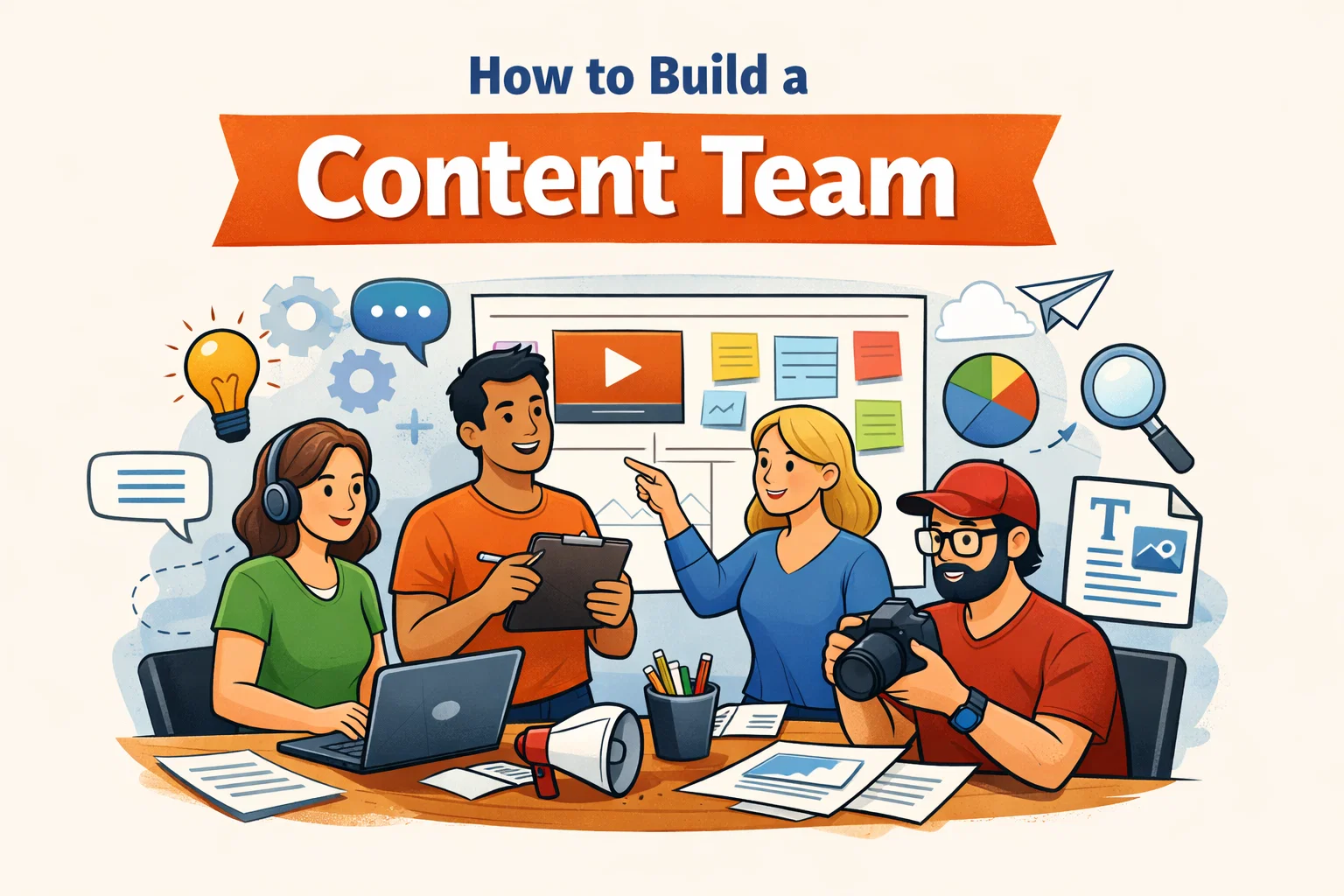
Building a content team is no longer about hiring a few writers and hoping for the best. Today, content drives growth, trust, discoverability, and long-term authority across search engines, social platforms, and AI-powered discovery systems.
This guide explains how to build a content team that actually performs. It covers roles, structure, hiring decisions, and how teams should evolve as companies grow, based on real operational needs rather than theory.
Why Building the Right Content Team Matters
A strong content team creates consistency, accountability, and measurable impact. Without the right structure, content efforts often become reactive, scattered, and dependent on individual contributors rather than repeatable systems.
The right team setup allows organizations to scale output without sacrificing quality. It also ensures that content aligns with broader business goals such as growth, retention, and authority, rather than existing in isolation. As content becomes a core channel across digital marketing, the cost of poor structure becomes increasingly visible in missed opportunities and wasted resources.
Job Titles vs. Actual Roles in a Content Team
Why titles matter less than ownership
Job titles vary widely across companies, but ownership is what determines effectiveness. A role without clear responsibility often leads to duplicated work, missed deadlines, or gaps in execution. Instead of focusing on labels, teams should define who owns strategy, production, quality, distribution, and performance. Clear ownership reduces friction and improves accountability across the entire content operation. This approach also makes it easier to adapt roles as the team grows without constantly changing titles.
How responsibilities evolve as teams scale
In small teams, one person may cover strategy, editing, publishing, and reporting. As the organization grows, these responsibilities naturally split into more specialized roles. Understanding this evolution upfront helps avoid premature hiring or unrealistic expectations. It also prevents burnout by aligning responsibilities with team size and maturity. Well-structured teams plan for this evolution instead of reacting to it.
How to Structure a Content Team: Step-by-Step
Step 1: Assess your goals and resources
The first step in building a content team is understanding what content needs to achieve. Goals may include organic growth, thought leadership, demand generation, or product education. Resources such as budget, internal expertise, and available tools determine how ambitious the structure can be. A realistic assessment prevents over-hiring or under-investing. Clear goals make every subsequent hiring decision easier and more defensible.
Step 2: Decide what stays in-house vs outsourced
Not every function needs to be handled internally. Strategy, editorial ownership, and quality control are typically best kept in-house. Execution-heavy tasks such as writing, design, or translation can often be outsourced without sacrificing quality. The key is maintaining strong internal ownership. This balance allows teams to scale output while keeping control over direction and standards.
Step 3: Build around core ownership, not headcount
Effective teams start with owners, not volume. A strong content lead or content manager provides direction, prioritization, and alignment. Without ownership, adding more contributors usually increases complexity rather than output. Core roles should be defined before expanding the team. This principle applies at every stage of growth.
Step 4: Fill skill gaps with specialists
Once ownership is established, teams can add specialists to cover gaps in SEO, design, analytics, or distribution. Specialists increase efficiency and depth, especially in competitive environments. However, they work best when guided by a clear strategy and editorial framework. Hiring specialists too early often leads to silos and misalignment.
Core Roles Every Content Team Needs
Content Strategy and Leadership Roles
Head of Content or Content Lead
This role owns the content vision, roadmap, and alignment with business objectives. They translate company goals into content priorities and measurable outcomes. A strong content lead also manages trade-offs, sets standards, and ensures the team is focused on impact rather than volume. In smaller teams, this role is often combined with editorial responsibilities.
Content Marketing Strategist
The strategist focuses on audience research, messaging, formats, and funnel alignment. Their job is to make sure content serves a purpose at every stage of the user journey. This role connects content creation with demand generation and brand positioning. It is especially important in B2B and growth-focused environments.
Data and Performance Analyst
Performance analysis turns content into a measurable growth asset. This role tracks KPIs, identifies trends, and feeds insights back into planning. Without data ownership, teams rely on assumptions rather than evidence. In smaller teams, this function may be shared with marketing or SEO roles.
Content Creation Roles
Managing Editor
The Managing Editor owns execution quality and workflow. They ensure content meets standards, deadlines, and editorial guidelines. This role often acts as the operational backbone of the team. Clear ownership here prevents chaos as output increases.
Writers and Subject Matter Experts
Writers create the core content assets, while subject matter experts provide depth and credibility. The strongest teams combine editorial skill with domain knowledge. This mix improves trust, authority, and long-term performance.
Editors and Proofreaders
Editors protect quality and consistency across all content. They refine structure, clarity, and tone. Even strong writers benefit from editorial oversight. This role becomes more critical as teams scale.
Designers and Visual Creators
Designers support engagement and comprehension through visuals, charts, and layout. Visual quality directly affects content performance across platforms. Design should be treated as part of content, not an afterthought.
SEO, AEO, and Technical Roles
SEO and AEO Specialist
This role ensures content is discoverable across search engines and AI-powered interfaces. They guide keyword strategy, internal linking, and technical optimization. Working with an experienced SEO consultant can accelerate maturity in this area.
Content Operations and CMS Support
Content operations roles manage tooling, workflows, and publishing systems. This function reduces friction and enables scale. It is often overlooked but critical for efficiency.
Distribution and Growth Roles
Content Distribution Strategist
Distribution ensures content reaches the right audience through the right channels. This role aligns content with amplification strategies and partnerships. Great content without distribution rarely performs.
Social Media Manager
Social media managers adapt content for platform-specific formats and audiences. Their work supports engagement, reach, and brand voice. Execution should align with a broader social media strategy.
Email Marketing Specialist
Email remains one of the highest-performing distribution channels. This role focuses on segmentation, messaging, and lifecycle communication. Strong alignment with content planning is essential.
Small Team vs Growing Team vs Enterprise Content Team
How to build a content team with 1–3 people
Small teams rely on generalists with strong ownership. One or two people may cover strategy, editing, and distribution. Clear prioritization and automation are critical at this stage. Outsourcing execution can extend capacity without hiring.
How roles change in a 5-10 person team
As teams grow, specialization increases. Dedicated editors, SEO roles, and distribution owners become viable. Processes and documentation become essential. This stage often defines long-term success or failure.
Structuring content teams at scale
Enterprise teams require governance, clear reporting lines, and cross-functional alignment. Specialization deepens, and operations become more formalized. At scale, consistency matters more than speed.
Hiring for a Content Team: What to Look For
Hiring criteria that actually matter
Strategic thinking, ownership, and communication skills often matter more than raw output. Strong candidates understand how content creates value. This mindset is harder to teach than technical skills.
Generalists vs specialists
Generalists are valuable early. Specialists add depth later. Timing matters more than preference. Teams that hire specialists too early often struggle.
Journalistic vs marketing backgrounds
Journalistic backgrounds bring rigor and storytelling skills. Marketing backgrounds bring conversion and funnel awareness. The best teams combine both.
Diversity of skills and perspectives
Diverse teams produce more resilient content strategies. Different perspectives improve creativity and relevance. Diversity should be intentional, not accidental.
Onboarding, Training, and Team Enablement
Creating clear ownership and expectations
Every role should have documented responsibilities. Ambiguity creates friction and frustration. Clear expectations accelerate onboarding.
Documentation, workflows, and style guides
Documentation scales knowledge beyond individuals. Style guides ensure consistency. Workflows reduce decision fatigue.
Teaching by process, not tribal knowledge
Relying on informal knowledge limits scale. Processes make teams resilient to change. This is critical for long-term stability.
How to Support and Retain a Content Team
Clear KPIs and feedback loops
KPIs align effort with outcomes. Feedback loops drive continuous improvement. Both should be transparent.
Career paths and promotion frameworks
Clear growth paths improve retention. People stay when they see a future. This is especially important in content roles.
Avoiding burnout in content teams
Content work is cognitively demanding. Realistic expectations and pacing matter. Burnout destroys long-term performance.
Common Mistakes When Building a Content Team
Hiring too fast without strategy
Speed without direction creates chaos. Strategy should come first. Hiring should follow.
Over-relying on freelancers without ownership
Freelancers extend capacity but cannot replace ownership. Internal leadership is non-negotiable. Balance is key.
Confusing content production with content leadership
Publishing content is not the same as leading content. Leadership aligns effort with impact. This distinction defines mature teams.
Frequently Asked Questions About Building a Content Team
How should a content team be structured?
A content team should be structured around ownership, not volume. Strategy, execution, and distribution should all have clear owners.
When should content be outsourced vs kept in-house?
Strategy and editorial ownership should stay in-house. Execution can be outsourced when processes are clear.
What does a Managing Editor actually own?
The Managing Editor owns quality, workflow, and editorial standards across all content outputs.
How many people do you need to start a content team?
One strong owner can start a content team. Scale comes later.
How do content teams change as companies grow?
Teams move from generalists to specialists, with stronger processes and governance over time.
Final Thoughts: Building a Content Team That Lasts
Building a content team is a long-term investment, not a hiring sprint. The strongest teams are designed for ownership, clarity, and adaptability. When structure, roles, and expectations are clear, content becomes a scalable growth engine rather than a constant operational challenge.