In this article
- Key Takeaways
- What Are AI Agents in Content Marketing?
- AI Agents vs Traditional Marketing Automation
- The Continuous Intelligence Loop
- How AI Agents Differ From Chatbots and Writing Tools
- How AI Agents Change the Content Marketing Workflow
- Topic Discovery and Ideation at Scale
- Strategic Planning and Content Mapping
- Autonomous Execution and Iteration
- Feedback Loops From Performance Data
- Core Capabilities of AI Agents for Content Marketing
- Data Perception and Analysis
- Reasoning and Decision Making
- Multi Modal Content Generation
- Personalization and Audience Adaptation
- Collaboration With Human Teams
- Practical Use Cases for AI Agents in Content Marketing
- SEO and Evergreen Content Production
- News and Trend Driven Content
- Content Optimization and Refresh Workflows
- Distribution and Performance Optimization
- Benefits of AI Agents for Content Teams
- Speed and Scalability
- Consistency and Brand Alignment
- Data Driven Creativity
- Reduced Manual Workload
- Risks and Challenges of Using AI Agents in Content Marketing
- Content Quality and Originality
- Over Automation
- Editorial Trust and Accountability
- Governance and Compliance
- Human and AI Collaboration: Where Editors Still Lead
- Editorial Judgment
- Voice and Authority
- Fact Checking and Accuracy
- Strategic Oversight
- How to Implement AI Agents in a Content Marketing Team
- Assess Data and Tooling Readiness
- Define Clear AI Usage Guidelines
- Start With Controlled Pilots
- Measure What Matters
- Measuring the Impact of AI Agents on Content Performance
- Search Visibility and Rankings
- Traffic and Engagement
- Operational Efficiency
- Long Term Content Value
- The Future of Agent Driven Content Marketing
- From Automation to Autonomy
- AI Agents as Operators, Not Writers
- What Content Leaders Should Prepare For
- Want AI agents working inside your content engine?
Key Takeaways
- AI agents are reshaping how content marketing teams plan, produce, optimize, and scale content.
- The real value of AI agents is not writing faster, but operating across the full content lifecycle.
- Human editors remain critical for strategy, quality control, and trust.
What Are AI Agents in Content Marketing?
AI agents in content marketing are autonomous systems designed to observe data, reason over objectives, take action, and continuously improve outcomes. Unlike traditional automation tools or standalone AI writers, agents operate across multiple steps of the workflow rather than executing a single task.
AI Agents vs Traditional Marketing Automation
Traditional automation follows predefined rules. AI agents adapt. They analyze performance data, adjust strategies, and iterate without requiring constant manual input from a content manager.
The Continuous Intelligence Loop
At the core of agent-based systems is a loop: observe data, reason about outcomes, act on insights, and learn from results. This allows content strategies to evolve in near real time.
How AI Agents Differ From Chatbots and Writing Tools
Chatbots generate responses. AI agents manage processes. In content marketing, this means planning topics, prioritizing formats, triggering updates, and evaluating success across channels.
How AI Agents Change the Content Marketing Workflow
Topic Discovery and Ideation at Scale
AI agents analyze search trends, user behavior, and competitor coverage to surface content opportunities that align with business goals.
Strategic Planning and Content Mapping
Rather than producing isolated articles, agents build structured content plans that support long term authority and topical depth.
Autonomous Execution and Iteration
Once objectives are defined, AI agents can coordinate drafting, optimization, internal linking, and publishing workflows.
Feedback Loops From Performance Data
Agents continuously evaluate rankings, traffic, and engagement, feeding insights back into future content decisions.
Core Capabilities of AI Agents for Content Marketing
Data Perception and Analysis
AI agents ingest large volumes of performance, audience, and search data to identify patterns humans would miss.
Reasoning and Decision Making
Beyond raw data, agents prioritize actions based on impact, effort, and strategic value.
Multi Modal Content Generation
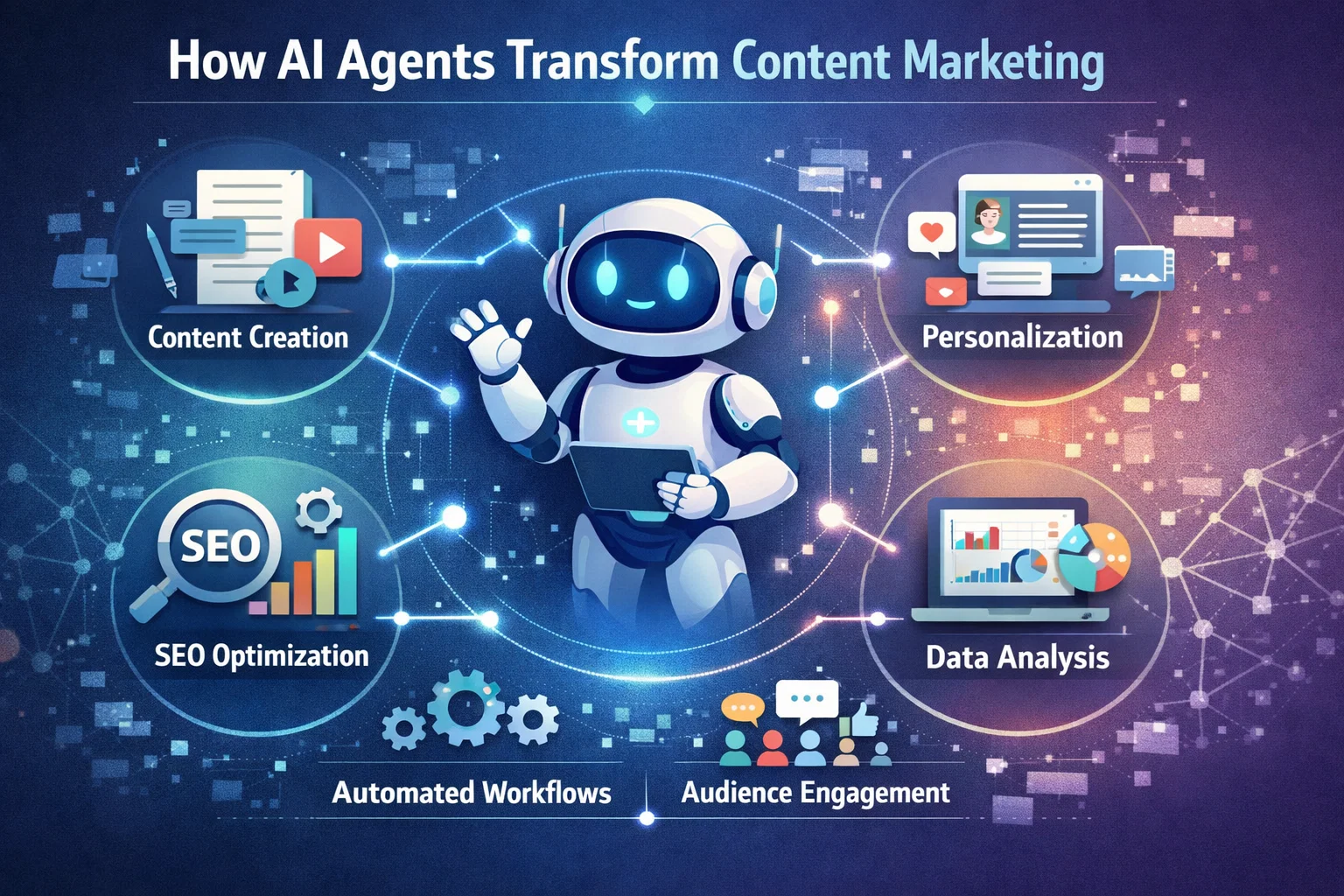
Modern agents can coordinate text, visuals, metadata, and structured data as part of a unified content marketing process.
Personalization and Audience Adaptation
Content can be adapted by audience segment, intent, or distribution channel.
Collaboration With Human Teams
AI agents support editors rather than replace them, escalating decisions when human judgment is required.
Practical Use Cases for AI Agents in Content Marketing
SEO and Evergreen Content Production
Agents help maintain large content libraries by identifying gaps, refreshing outdated pages, and improving internal structure with guidance from an SEO consultant.
News and Trend Driven Content
AI agents monitor emerging topics and coordinate rapid coverage without sacrificing consistency.
Content Optimization and Refresh Workflows
Existing content is continuously reviewed and updated based on performance signals.
Distribution and Performance Optimization
Agents support channel specific optimization, including email, organic search, and social media strategy.
Benefits of AI Agents for Content Teams
Speed and Scalability
Teams can produce and maintain more content without linear increases in headcount.
Consistency and Brand Alignment
Agents enforce guidelines across large content portfolios.
Data Driven Creativity
Creative decisions are informed by real performance data rather than intuition alone.
Reduced Manual Workload
Editors spend less time on repetitive tasks and more time on strategy and quality.
Risks and Challenges of Using AI Agents in Content Marketing
Content Quality and Originality
Without strong oversight, agent generated content can drift toward generic output.
Over Automation
Not every editorial decision should be delegated to machines.
Editorial Trust and Accountability
Clear ownership is required for content produced with AI assistance.
Governance and Compliance
AI usage must align with brand, legal, and regulatory standards.
Human and AI Collaboration: Where Editors Still Lead
Editorial Judgment
Humans define priorities, narratives, and strategic direction.
Voice and Authority
Distinctive tone and expertise remain human responsibilities.
Fact Checking and Accuracy
Final accountability for accuracy always rests with editors.
Strategic Oversight
AI agents execute strategy. Humans define it.
How to Implement AI Agents in a Content Marketing Team
Assess Data and Tooling Readiness
Strong analytics and clean data are prerequisites.
Define Clear AI Usage Guidelines
Set boundaries on where and how agents can operate.
Start With Controlled Pilots
Test agents on limited scopes before scaling.
Measure What Matters
Success should be evaluated through impact, not volume.
Measuring the Impact of AI Agents on Content Performance
Search Visibility and Rankings
Track improvements across priority queries.
Traffic and Engagement
Evaluate user behavior beyond pageviews.
Operational Efficiency
Measure time saved across planning and execution.
Long Term Content Value
Assess durability and compounding returns.
The Future of Agent Driven Content Marketing
From Automation to Autonomy
AI agents will increasingly manage end to end workflows.
AI Agents as Operators, Not Writers
The future is operational intelligence, not automated prose.
What Content Leaders Should Prepare For
Teams that invest early in agent driven systems will set the pace for the next phase of digital marketing.
Want AI agents working inside your content engine?
Reading about what agents can do is one thing. Getting them to do reliable work inside your actual workflows is another, and it is where most teams stall. We build the agents and the automations around them, validated so a probabilistic model becomes leverage instead of a machine for scaling mistakes. If you want agents running real parts of your content operation, our automation workflows and consulting are built for exactly that. Book a free call to map your first agent workflow.