In this article
- Key takeaways
- What is a content manager?
- How is a content manager different from a strategist, a marketing manager or a creator?
- What does a content manager actually do all day?
- What separates a good content manager from an average one?
- What skills does a content manager need in 2026?
- How much does a content manager earn in 2026?
- United States (annual, USD)
- United Kingdom (annual, GBP)
- Israel (ILS)
- How do you become a content manager?
- Why is the content manager role coming apart?
- Frequently asked questions
- Is a content manager the same as a content strategist?
- Do content managers need to know SEO?
- Do content managers write?
- What qualifications do you need to be a content manager?
- How long does it take to become a senior content manager?
- Should a small business hire a content manager?
Key takeaways
- A content manager owns the content lifecycle end to end: strategy, production, publishing, optimization and performance. The job is running the system, not writing the words.
- The role is quietly splitting into four specialisms that one salary no longer covers, which is why more companies now buy the function instead of the headcount.
In 2016 I took a junior content manager job at 888 Holdings. By 2024 I was leading content across the 888 and William Hill brands, plus Mr Green, WinkSlots and WinkBingo, with four people in-house and around fifty freelancers on the roster. Same job title family. Four completely different jobs.
That gap is what most articles about this role miss. They describe a set of tasks. The tasks are the easy part.
What is a content manager?
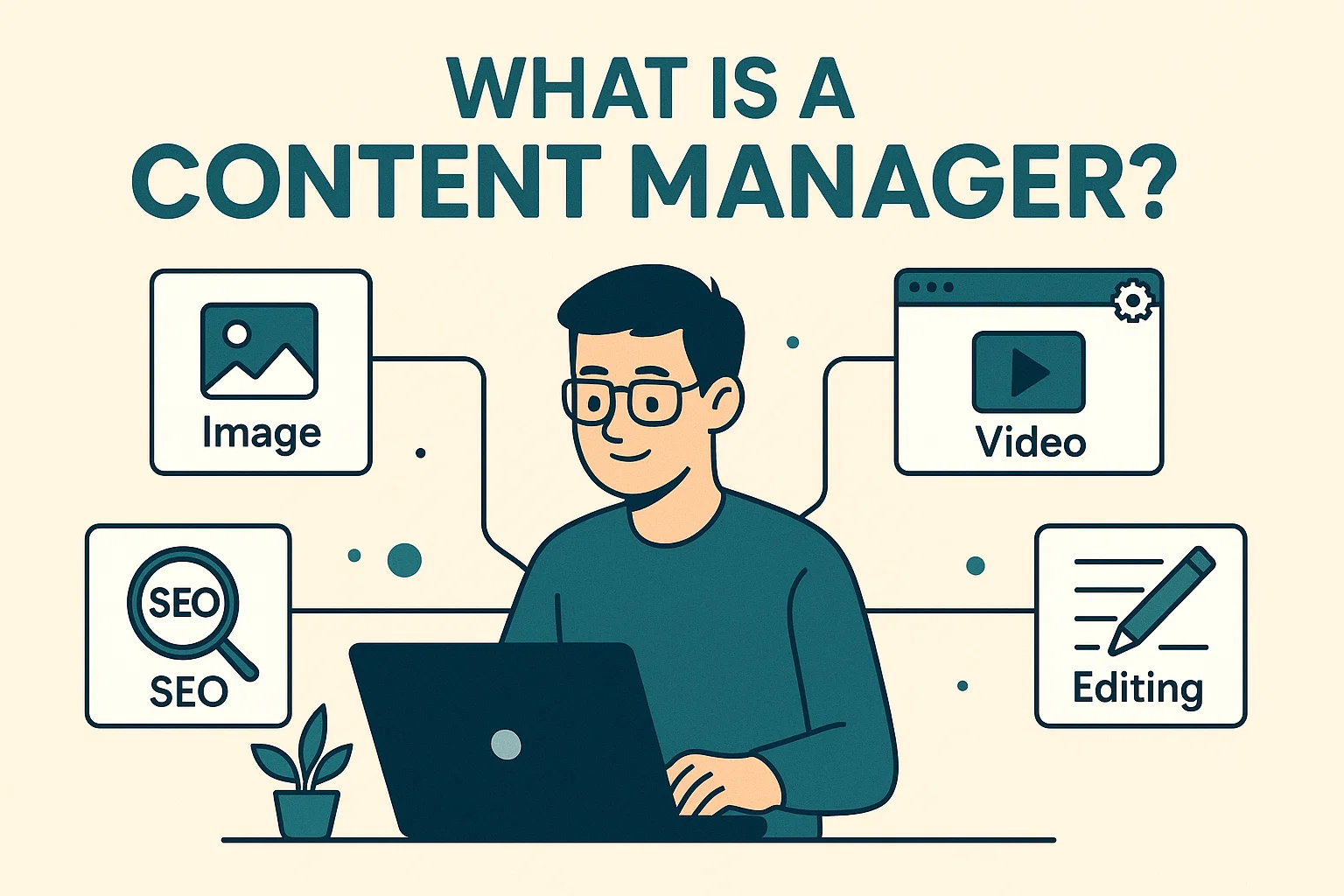
A content manager is the person accountable for a company’s content from planning through to performance. They decide what gets published, who produces it, how it is optimized for search and AI visibility, when it goes live, and whether it worked.
The defining feature is ownership of the system, not authorship of the pieces. A content manager can go a full month without writing a word and still be doing the job well. What they cannot do is lose track of what is in production, what is underperforming, and what should never have been commissioned in the first place.
How is a content manager different from a strategist, a marketing manager or a creator?
These four titles get used interchangeably in job ads, which is why so many hires go wrong. They are different jobs with different failure modes.
| Role | Owns | Primary output | Fails when |
|---|---|---|---|
| Content manager | The content operation end to end | A running publishing system | The pipeline stalls or quality drifts |
| Content strategist | What to say and why | Strategy, messaging, roadmap | Strategy never survives contact with production |
| Content marketing manager | Campaigns and demand | Pipeline and leads | Content gets traffic but no conversions |
| Content creator | The asset itself | Articles, video, design | Output is good but disconnected from goals |
The practical test: a strategist tells you which mountain to climb, a content manager gets the expedition up it, a marketing manager makes sure someone is watching, and a creator carries the gear. Companies that hire a creator and expect a manager end up with beautiful content and no engine. If the split you actually need is on the search side, that is a different hire again, closer to what an SEO manager does.
What does a content manager actually do all day?
As a junior in 2016 and 2017, my day was the CMS. Uploading, formatting, checking that images had alt text, chasing a writer who was two days late, fixing a headline that broke on mobile. Useful work. Almost entirely operational.
By 2021, running the team, the day looked nothing like that. Most of it was deciding what not to publish. Reviewing briefs before anyone wasted a week on them, killing topics that had no chance against the sites already ranking, arguing with stakeholders who wanted a page for a product nobody searched for, and reading performance data to figure out which of last quarter’s fifty articles deserved an update instead of a replacement. That last habit is a discipline in itself, and it starts with knowing how to measure content performance properly.
The constant across both levels is the calendar and the queue. Everything else changes with seniority. Junior content managers execute the plan. Senior content managers decide whether the plan is worth executing, and that decision is worth more than any individual piece. The planning half of it is a craft of its own, and most teams get further with a documented content strategy than with more output.
The other permanent job is people. At peak I had two content managers, a web developer and a graphic designer in-house, and roughly fifty freelancers, mostly writers and working journalists. Managing that many contributors is where most content managers actually struggle. The writing is never the bottleneck. Briefing, standards and turnaround are.
What separates a good content manager from an average one?
Internal linking, and knowing when to stop.
This is the single most underrated lever in the job, and it is the thing I would test for if I were hiring. On a blog, internal links are gold. Most content managers add two or three per article because a plugin told them to. On the sites I ran, we linked generously, well beyond what standard advice suggests, as long as every link genuinely served the reader. Search engines use those links to work out which pages represent your real expertise, and readers who follow them stay. If you are building topical authority, this is how it gets built. Our organic traffic went from zero to millions of sessions a year, and roughly 95 percent of it was organic. Internal linking discipline was a large part of why. The same logic is what makes content gap analysis pay off, because a gap you fill with no route into it from the rest of the site is a page nobody finds.
The part almost nobody gets right is the exception. On news stories, do the opposite. Keep them clean. A breaking story is a link magnet, and every internal link you stuff into it dilutes the thing that makes other publications and aggregators point at you. In a newsroom, links serve the reporting, not the keyword map. Mixing the two costs you the links you actually wanted.
The other thing worth saying plainly, because the industry has convinced itself otherwise: written guides still work. Not every topic needs video. If the search intent is someone trying to understand or decide something, a well-structured written page beats a five-minute video every time, and it is far easier to keep current.
What skills does a content manager need in 2026?
Editorial judgment first. You have to be able to look at a draft and know whether it is fixable or whether it needs to be scrapped, and to make that call in minutes rather than days.
Then search. Not keyword tools, but an understanding of why a page ranks and, increasingly, why it gets cited. Since AI Mode became the default in Google Search, ranking in the top ten no longer guarantees you appear in the answer at all. Pages with clean, extractable answers, question-shaped headings, named specifics and real author credentials get cited. Vague pages get skipped even at position three. That changes how a content manager briefs a writer, and it is why AI search visibility is now part of the job description rather than a separate project.
Analytics literacy comes next, and it is where most candidates fall down. You do not need to build dashboards. You do need to look at Search Console, spot an impressions-up, clicks-down pattern, and understand what it means.
After that: a CMS you can move quickly in, enough HTML to fix what the editor breaks, and increasingly some automation ability, because the parts of this job that are repetitive are now genuinely automatable. AI agents handle a real share of content workflow now, and a content manager who cannot brief one is working harder than they need to.
The soft skill that matters most is the willingness to say no to a stakeholder. Every content operation I have seen fail, failed because nobody would.
How much does a content manager earn in 2026?
Salary data for this role is unusually messy, because sources conflate content manager, digital content manager and content marketing manager. Treat the numbers below as ranges, not precise figures, and note that the sources disagree with each other.
United States (annual, USD)
| Level | Range | Source |
|---|---|---|
| Content manager, average | $79,500 to $89,300 | Comparably, Indeed, Built In |
| Content manager, 7+ years | ~$109,000 | Indeed |
| Senior content manager | $124,000 to $139,400 | Indeed, Glassdoor |
| Senior, 75th percentile | ~$180,800 | Glassdoor |
United Kingdom (annual, GBP)
| Level | Range | Source |
|---|---|---|
| Content manager, UK average | ~£37,600 | Indeed UK |
| Content manager, London | ~£41,000 | Indeed UK |
| Digital content manager, median | £45,000 | IT Jobs Watch, to June 2026 |
| Web content manager, London | £40,000 to £70,000 | Morgan McKinley 2026 guide |
Israel (ILS)
| Level | Range | Source |
|---|---|---|
| Content manager, Tel Aviv | ₪10,400 to ₪18,300 monthly | Glassdoor |
| Content manager, 1 to 4 years | ~₪120,000 annual | PayScale |
| Content manager, 5 to 9 years | ~₪200,000 annual | PayScale |
| Digital content manager | ~₪209,000 annual | SalaryExpert |
The pattern that holds across all three markets: the jump from mid-level to senior is worth more than any other move in this career, because senior is where the job changes from executing to deciding.
How do you become a content manager?
I started as a content editor at Sport5 in 2010, writing and editing sports coverage. That is still the most common entry route, and it is a good one, because you learn what makes a piece work before you are responsible for a hundred of them.
The other reliable paths in are SEO specialist and marketing coordinator. What matters more than the title is whether you have owned something end to end. Running your own site, managing a blog, or taking full responsibility for one content channel inside a bigger role teaches you more than any certificate, because it forces you to live with your own decisions for long enough to see whether they worked.
Why is the content manager role coming apart?
Here is the honest conclusion from doing this job at four levels over fourteen years.
The role I was hired into in 2016 was one job. The role as it exists in 2026 is four: content strategy, search and AI visibility, editorial production, and automation. Those are separate skill sets, and almost nobody is strong at all four. When you hire one content manager, you are betting your entire content engine on whichever of those four they are weakest at, and you usually find out which one about eight months in.
That is not an argument against hiring. It is an argument for being clear about which of the four you are actually buying, and how you cover the rest. Some companies solve it with a senior manager plus specialist support. Some solve it by running the function as a system rather than a salary, with strategy, production, publishing and analytics handled by a team that already has the four skill sets in place.
It is the reason I built Content Managers. Not because the role is obsolete, but because I spent fourteen years watching it become four roles while the job spec stayed the same.
If you are reading this to decide whether to hire, work out which of the four gaps is actually hurting you before you write the job ad. That one decision will save you more than any interview process.
Frequently asked questions
Is a content manager the same as a content strategist?
No. A strategist decides what the company should say and why. A content manager is accountable for producing, publishing and improving it. Small companies often combine the two roles in one hire, which works until volume grows.
Do content managers need to know SEO?
Yes. Since AI Mode became the default in Google Search, a content manager also needs to understand citation readiness, meaning clean answer blocks, question-shaped headings and verifiable claims. Ranking alone no longer guarantees visibility.
Do content managers write?
Some do, most do less over time. Junior content managers often write and edit. Senior content managers spend their time on prioritization, standards and performance, and commission the writing out.
What qualifications do you need to be a content manager?
No formal qualification is required. Employers weigh demonstrated ownership of a content operation far more heavily than certificates. A portfolio showing traffic or performance you were responsible for is the strongest credential.
How long does it take to become a senior content manager?
Typically four to seven years, moving through writing or editing, then content management, then team leadership. The transition point is when you start being measured on outcomes rather than output.
Should a small business hire a content manager?
Only if there is enough volume to keep one busy and enough budget to cover the specialist skills they lack. Below that threshold, most companies get better results buying the function than the headcount.