In this article
- Google announced two new ad formats at Marketing Live 2026 that place paid placements directly inside AI Mode answers.
- Gemini now generates ad creative per query in real time, which changes what you optimize, not how you write copy.
- If your Q3 paid and organic budgets were built around the old search model, they need a second look now.
Most marketing teams set their Q3 budget before Google Marketing Live. That was May 20. That timing matters now. What Google announced that day is not a format refresh. It is a structural change to where paid and organic compete for attention, and the window between knowing and adjusting is closing fast.
What Google actually announced
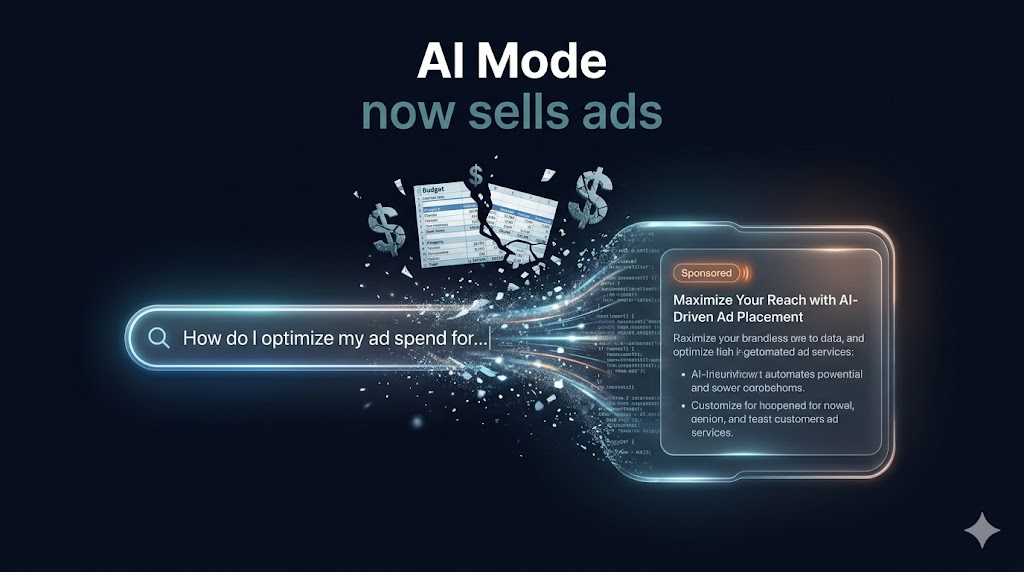
At Google Marketing Live 2026, Google introduced two Gemini-powered ad formats built specifically for AI Mode: Conversational Discovery ads and Highlighted Answers. According to Google’s official announcement, both formats sit inside AI Mode responses and carry a “Sponsored” label. Gemini generates both in real time based on the query. You do not serve a static creative you built in advance.
Conversational Discovery ads answer a user’s specific question directly inside AI Mode. Gemini writes the creative to match the conversation. Highlighted Answers place high-quality ads inside AI Mode list responses, the kind AI produces when someone asks for the best app, tool, or service for a specific purpose. Both formats are currently in testing in the US.
Google is not likely to walk this back. AI Mode passed one billion monthly users the same week Google made this announcement. The ad layer was always coming. Now it has a name and a rollout timeline.
Why does this change how you allocate budget?
Until now, the AI Mode conversation for most marketing teams focused on organic visibility: how do you get cited in an AI answer instead of buried below it? That question is still the right one. But it now has a paid counterpart running in the same space.
The implication for budget is not that you should immediately shift spend. It is that the model your Q3 plan relies on is no longer accurate. Paid search and organic content no longer operate in separate lanes. They now compete for the same surface inside the same answer box. If your paid and content teams are not talking about this yet, that is the first thing to fix.
On the paid side, the creative optimization logic changes. Gemini generates the ad from your product data and assets. It does not use a headline you wrote. Your Merchant Center feed, your asset diversity, and your landing page quality are the actual creative inputs now. Teams that optimize ad copy the old way are optimizing the wrong thing.
What this means for the Q3 plan you already have
If your team finalized the Q3 budget before May 20, three specific lines are worth reviewing now.
First, check any spend on brand awareness through Search. AI Mode is now the default interface for a large and growing share of queries. An impression in AI Mode and an impression in the old ten-link SERP are not the same thing. Your current targets probably do not reflect that difference.
Second, look at content investment earmarked for SEO traffic. Organic content that ranks but does not get cited in AI Mode answers generates less value than it did in 2024. That is not speculation. It is the direct consequence of AI Mode becoming the global default in May 2026.
Third, review any campaign type that relies on keyword-matched creative. The Conversational Discovery format targets that same user at that same moment, with dynamic creative Google considers more relevant. That is a competitive pressure on your existing campaigns that was not in the model when budgets were set.
The actual to-do before Q3 starts
You do not need a full budget restructure this week. You need one honest conversation between whoever owns paid search, whoever owns content, and whoever signs off on Q3 performance targets. Put one question on the table: does our current plan account for a search environment where Google’s AI fills both organic and paid positions, generates creative dynamically, and treats the answer box as a single surface?
If the answer is no, you still have time to adjust. But the window is shorter than it looks. Conversational Discovery and Highlighted Answers are in testing now. By Q4 planning, they will likely be standard inventory. Teams that understood the shift in Q3 will have real data to work with. Teams that waited will be catching up with someone else’s playbook.