In this article
- Why do sessions undercount content value when clicks fall?
- How do you measure AI search visibility in Search Console?
- How do you track ChatGPT and Perplexity referral traffic in GA4?
- Citation rate: are you in the answer or outside it?
- AI share of voice: how do you compare with competitors?
- How does branded search show that AI answers mention you?
- What should a zero-click content dashboard include?
- Frequently asked questions
- How do I measure AI search traffic?
- Does Search Console show clicks from AI Overviews and AI Mode?
- Where does ChatGPT traffic show up in GA4?
- How much do AI Overviews reduce CTR?
- How do you present this to leadership?
- Sources
- To measure AI search traffic in 2026, combine three sources: Search Console’s generative AI report for impressions in AI Overviews and AI Mode, GA4 referrals from chatgpt.com, perplexity.ai, gemini.google.com and copilot.microsoft.com, and a monthly prompt test for citation rate and AI share of voice.
- AI Overviews correlate with a 58% lower average click-through rate for top-ranking pages, according to Ahrefs, so sessions alone undercount what content does.
- Report content in four tiers: traditional search, technical health, AI visibility and AI referrals, each with a named source and a fixed review cadence.
Updated October 2026 with Ahrefs’ 2026 click data, Search Console’s generative AI report and a GA4 setup for AI referrals.
Your content is ranking. Traffic is down. Your manager is asking why the blog is “not working,” and the dashboard you inherited has no column that answers the question.
The problem sits in the measurement. As of October 2026, Google reports AI impressions in Search Console, AI assistants send measurable referral traffic, and the old sessions-first dashboard sees neither. This walkthrough rebuilds it.
Why do sessions undercount content value when clicks fall?
Sessions undercount content value because AI answers now satisfy many searches on the results page, so a page can inform the buyer without earning the visit. Ahrefs compared 300,000 keywords in December 2025 with December 2023 and found AI Overviews correlate with a 58% lower average CTR for the top-ranking page, up from 34.5% in its April 2025 study.
Seer Interactive’s 2026 update across 53 brands shows the same gap from another angle: in February 2026, organic CTR was 2.36% on queries with an AI Overview and 3.82% on queries without one. The same study found that being cited inside the AI Overview delivered 120% more organic clicks per impression than not being cited. That finding changes the job of measurement. The question to track is whether you appear in the answer, and the click follows from that.
Sessions still work for transactional and navigational queries. For the informational queries most content programs target, an SEO manager presenting strong rankings next to falling traffic now looks like they are losing the argument, even when the content is doing its job.
How do you measure AI search visibility in Search Console?
Use Search Console’s generative AI performance report, which counts how often links to your site appeared in AI Overviews and AI Mode, by page, country, device and date. Google introduced the report in June 2026, and Search Engine Journal reported it rolled out worldwide on 31 August 2026, with a separate view for generative AI features in Discover.
Three limits matter for reporting. The report shows impressions only, with no click data as of October 2026. Google’s help page says not every property has access yet and that sites without enough AI impressions may see no data. And a property-level control launched alongside it lets a site opt out of those AI surfaces, so check that nobody on your team switched it on. We walk through the report step by step in Search Console’s generative AI report.
Even without clicks, this is the first first-party number for AI visibility. Track it per page cluster monthly, next to organic clicks.
How do you track ChatGPT and Perplexity referral traffic in GA4?
Create a custom channel group in GA4 with an “AI assistants” channel whose source matches chatgpt.com, perplexity.ai, gemini.google.com or copilot.microsoft.com, and place it above the Referral channel. According to Google’s Analytics help page on custom channel groups, you do this under Admin, Data display, Channel groups, by creating a new channel group and adding a channel with a Source condition set to “matches regex.”
A workable pattern is chatgpt\.com|perplexity\.ai|gemini\.google\.com|copilot\.microsoft\.com. Order matters, because GA4 assigns each session to the first channel whose rules it matches, so move the new channel above Referral. Google states that custom channel groups apply to reports retroactively, and standard properties can hold two custom groups besides the default one. For a quick look without changing settings, an exploration filtered on session source with the same pattern gives the same answer.
Treat the result as a floor. Some visits from AI apps can arrive without referrer data and land in Direct. Watch the trend and the conversion rate of these sessions, which tell you whether AI-referred visitors arrive further along in their decision.
Citation rate: are you in the answer or outside it?
Citation rate is the share of a fixed set of buyer questions for which an AI engine cites your domain. Pick 20 to 50 questions your buyers ask, run them monthly in Google AI Mode, ChatGPT, Perplexity and Gemini, count the answers that cite you, and divide by the total.
Keep the prompt set stable and log the date, engine and cited domains, because engines change their sourcing without notice. In August 2026, ChatGPT’s Reddit citations fell 73.4% in days, per OtterlyAI, while official brand pages gained in 10 of 15 reports. A monthly log is how you catch that kind of shift in your own category.
AI share of voice: how do you compare with competitors?
AI share of voice is your citations divided by all citations to you and your main competitors across the same prompt set. The calculation matches traditional share of voice, with AI answers as the surface. Several AI visibility tools now track it automatically, and a spreadsheet works for a first baseline.
Citation share is built across SEO, content, PR and partner pages at once, and it exposes the competitor who wins AI answers with less organic traffic than you.
How does branded search show that AI answers mention you?
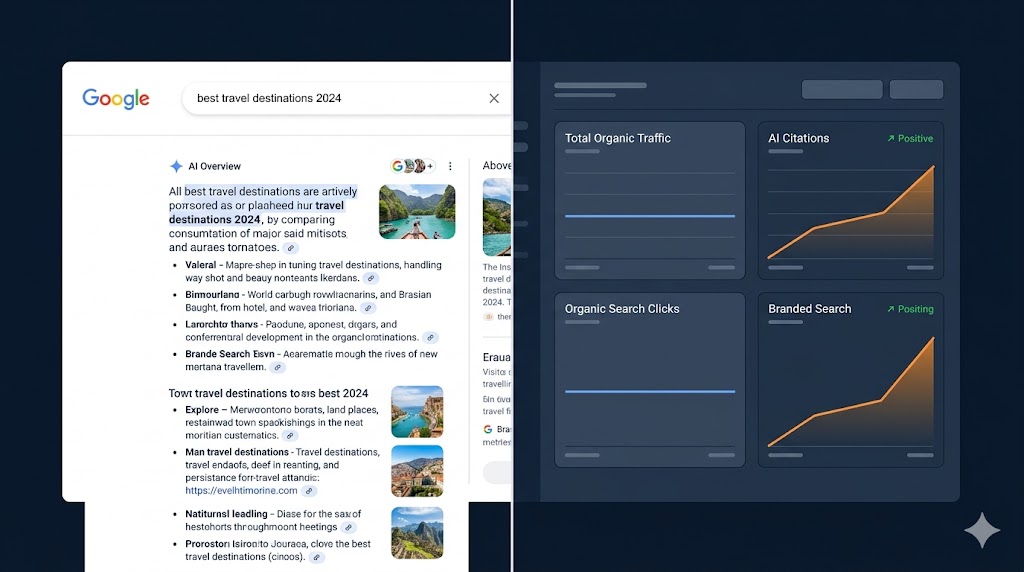
Growing branded search in Search Console, while non-branded clicks fall, is the clearest downstream sign that AI answers are mentioning you. Someone who reads your name in an AI answer and later searches for it leaves that trace in your Performance report.
Filter the Performance report by queries containing your brand, chart the trend, and set it next to AI impressions from the generative AI report. If both rise together, you have a measurement story that connects zero-click visibility to demand.
What should a zero-click content dashboard include?
A zero-click dashboard needs four tiers: traditional search, technical health, AI visibility and AI referrals, each with its own source and cadence. Earlier versions of this article proposed three tiers. GA4 referral data from AI assistants is now reliable enough to earn its own row.
| Tier | Metric | Source | Cadence |
|---|---|---|---|
| Traditional | Organic sessions, rankings, organic conversions, branded query clicks | GA4, Search Console Performance report | Monthly |
| Technical | Crawlability, Core Web Vitals, structured data, AI crawler access | Search Console, site crawler, server logs | Monthly, plus after every release |
| AI visibility | AI impressions by page, citation rate, AI share of voice | Search Console generative AI report, monthly prompt test | Monthly |
| AI referrals | Sessions and conversions from chatgpt.com, perplexity.ai, gemini.google.com, copilot.microsoft.com | GA4 custom channel group | Weekly trend, monthly report |
The work that moves the AI tiers is the work that always built authority: original data, clear passages a retrieval system can quote, topical depth with clean internal links, and consistent author signals. For the technical side of how AI systems find content, the question of whether llms.txt affects your visibility in LLMs is worth reading alongside this framework.
Frequently asked questions
How do I measure AI search traffic?
Measure AI search traffic with three sources. Search Console’s generative AI report shows impressions in AI Overviews and AI Mode. A GA4 custom channel group isolates sessions from chatgpt.com, perplexity.ai, gemini.google.com and copilot.microsoft.com. A monthly prompt test gives citation rate and share of voice. Together they cover visibility, visits and competitive position.
Does Search Console show clicks from AI Overviews and AI Mode?
No, as of October 2026 the generative AI report in Search Console shows impressions only. It groups them by page, country, date and device. Search Engine Journal reported it had no click data at its worldwide rollout on 31 August 2026. Use GA4 and branded search trends to estimate the downstream effect until Google adds clicks.
Where does ChatGPT traffic show up in GA4?
By default, ChatGPT visits with referrer data appear under Referral with chatgpt.com as the source. Some visits from apps can arrive without a referrer and fall into Direct. A custom channel group with an AI assistants channel above Referral groups these sessions in one place, and Google says the grouping applies to past data as well.
How much do AI Overviews reduce CTR?
AI Overviews correlate with a 58% lower average CTR for the top-ranking page, according to Ahrefs, comparing December 2025 with December 2023 across 300,000 keywords. Seer Interactive measured 2.36% organic CTR with an AI Overview and 3.82% without in February 2026. Pages cited inside the AI Overview earned 120% more clicks per impression than uncited ones.
How do you present this to leadership?
Present content performance as four tiers with a baseline month, and show AI impressions, AI referrals and branded search next to organic sessions. A falling session line reads very differently when AI impressions and branded demand rise beside it, and the baseline you set now becomes your evidence in six months.
If you need the underlying page-level method, start with how to measure content performance, then extend it with the AI tiers. If you want the framework built into your reporting and content plan, that is part of our digital marketing services.
Sources
- Ahrefs, Update: AI Overviews Reduce Clicks by 58%
- Seer Interactive, AIO Impact on Google CTR: 2026 Update
- Google Search Central Blog, Introducing Search Generative AI performance reports in Search Console
- Google Search Console Help, Generative AI performance report (Search)
- Search Engine Journal, Google Search Console AI Reports Rolled Out Worldwide
- Google Analytics Help, Custom channel groups
- OtterlyAI, ChatGPT Reddit citations analysis (August 2026)