In this article
Search traffic is collapsing for publishers. Small sites have lost around 60 percent of their search referrals in two years. In February 2026 the Washington Post cut roughly a third of its newsroom, with its executive editor pointing to organic search that had fallen by nearly half in three years as AI reshaped discovery. Among the casualties: the Post’s entire sports section. AI answers now end most searches before a click ever happens.
But there is one category the AI summary cannot eat: live sport. You cannot pre-summarize a goal that has not been scored yet.
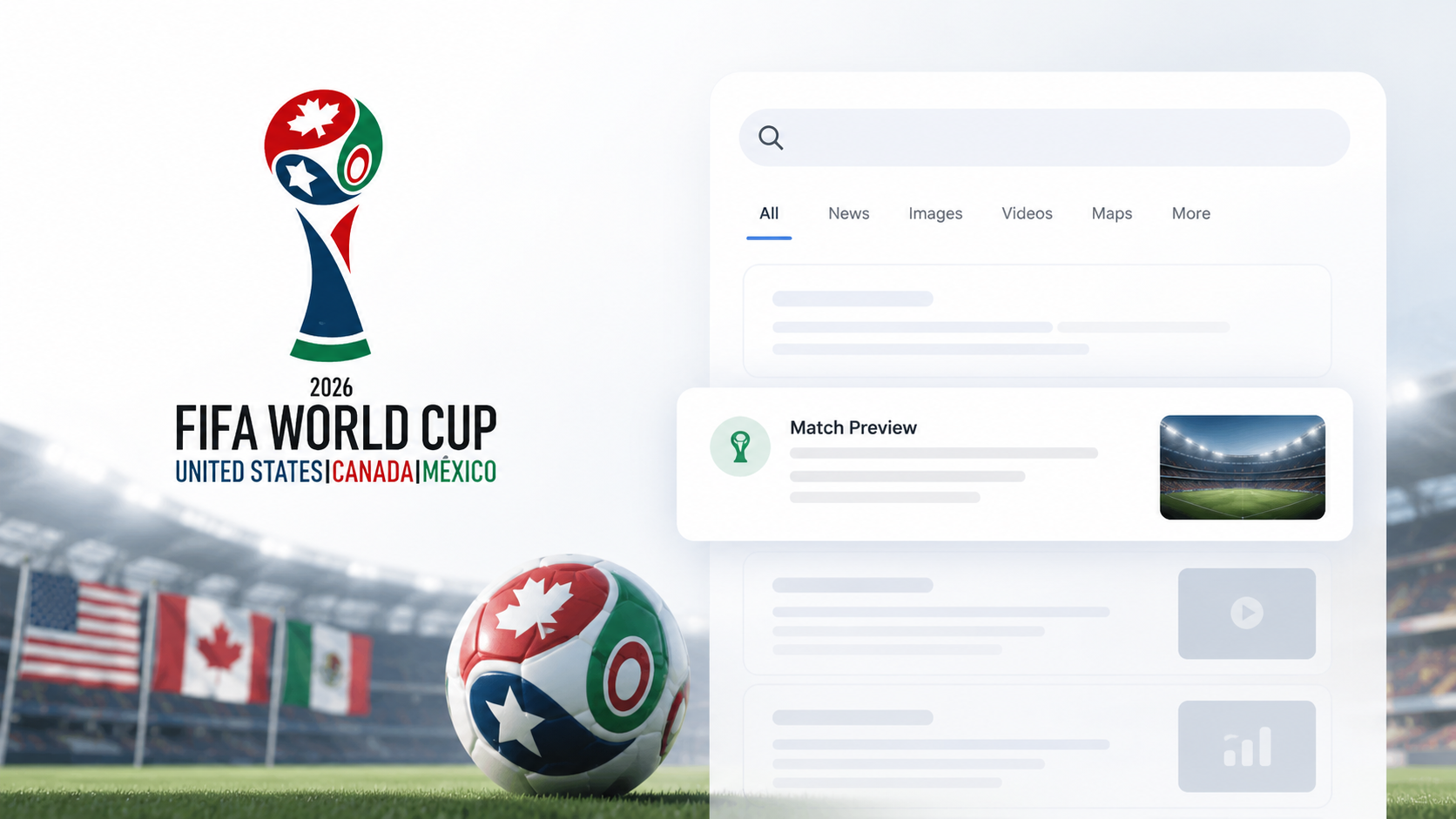
For 39 days starting June 11, the World Cup will generate exactly the content AI search is worst at replacing. The publishers who can move at the speed of the match will capture attention everyone else has lost. Here is how to build for it.
The collapse, and the one exception
The numbers are brutal and well documented. Chartbeat data puts the two-year search referral decline at 60 percent for small publishers, 47 percent for medium, and 22 percent for large. Zero-click searches now make up the majority of all queries. For most content categories, the deal that powered the open web for two decades is breaking.
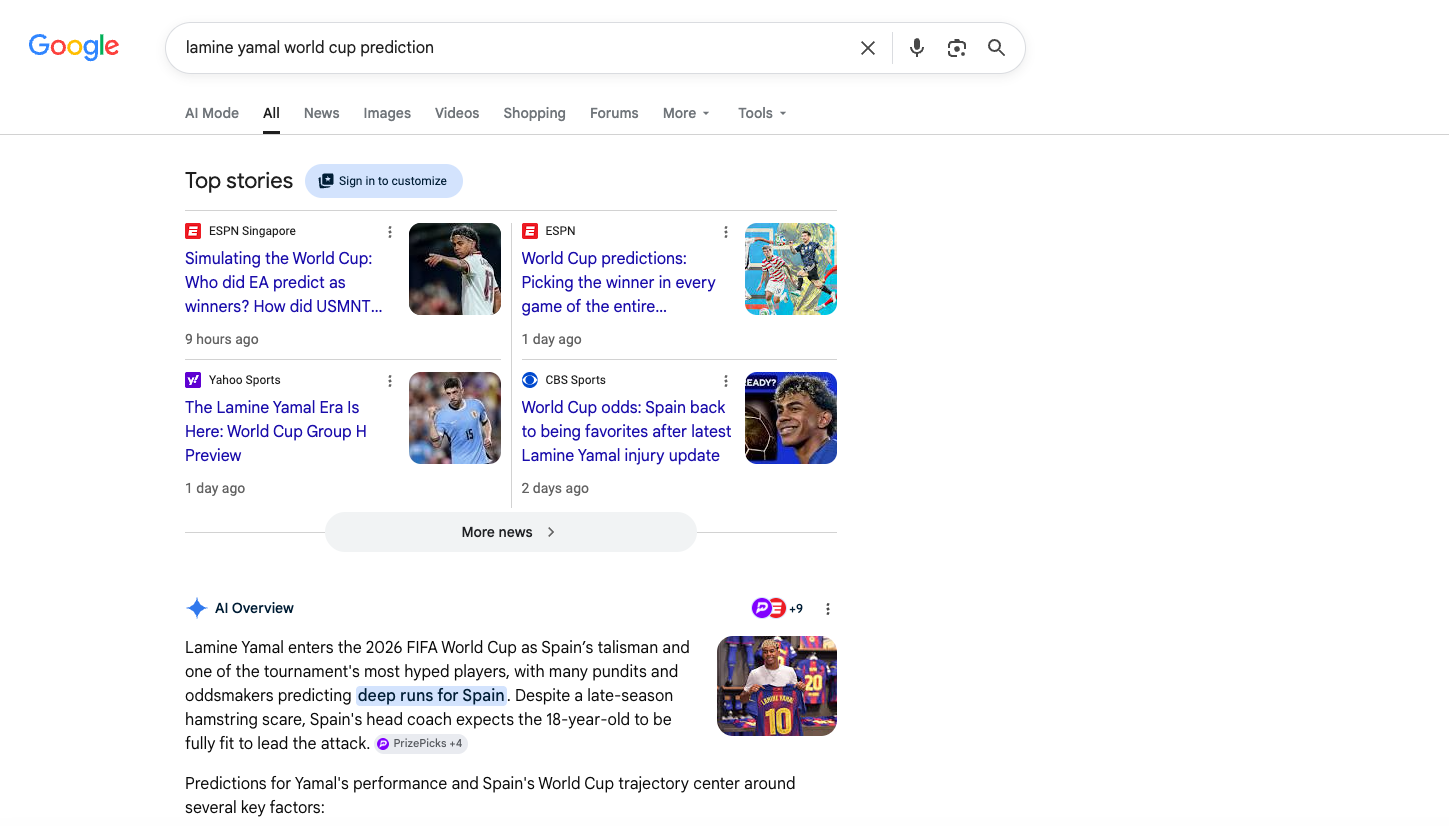
Then there is the exception. Research from Ahrefs across 146 million search results found that AI Overviews are less likely to appear on time-sensitive, local, and sports queries. The reason is simple and structural. An AI Overview works by summarizing information that already exists. Live sport, by definition, is information that does not exist yet. The model has nothing to summarize until the match is played.
That is not a loophole. It is a durable property of the category. And the World Cup is the largest concentration of it on the calendar.
Why live sport resists AI summarization
I have spent enough time in broadcast booths and editing World Cup coverage to know where the value actually sits. It is not in the box score. It is in the moment, the reaction, and the context delivered while emotion is still high.
Three things make live sport hard for an answer engine to intercept:
Timing. The peak demand for a match reaction happens in the minutes after the final whistle, not hours later. AI systems lag the live event. Your published reaction does not.
Volatility. Fixtures, lineups, and knockout permutations change constantly across a 48-team, 104-match tournament. Static summaries go stale fast. Real-time updates do not.
Voice. Fans do not just want the result. They want a take, an argument, a read on what it means. That is judgment, not retrieval, and it is the part of publishing that survives.
The mistake is assuming this protection is permanent and automatic. It is not. It only holds if you actually publish at the speed the moment rewards. Most desks cannot, and that is the real problem to solve.
Where AI will still intercept you, and what to do about it
Be honest about the other half of your traffic. A large share of World Cup search is not live at all. It is evergreen and explanatory: how the new 48-team format works, a player’s background, head-to-head history, past tournament records, venue and city guides. That content is exactly what AI Overviews and assistants summarize well, and you will lose much of that click traffic no matter how good the article is.
Fighting that is a losing battle. The better move is to optimize that content to be cited rather than clicked. When a fan asks an AI assistant about a group’s permutations or a striker’s tournament record, you want your publication named as the source. That means clean structure, clear factual statements, accurate data, and content an engine can extract confidently. This is the discipline behind AI search visibility work: building content that machines quote and attribute, not just rank.
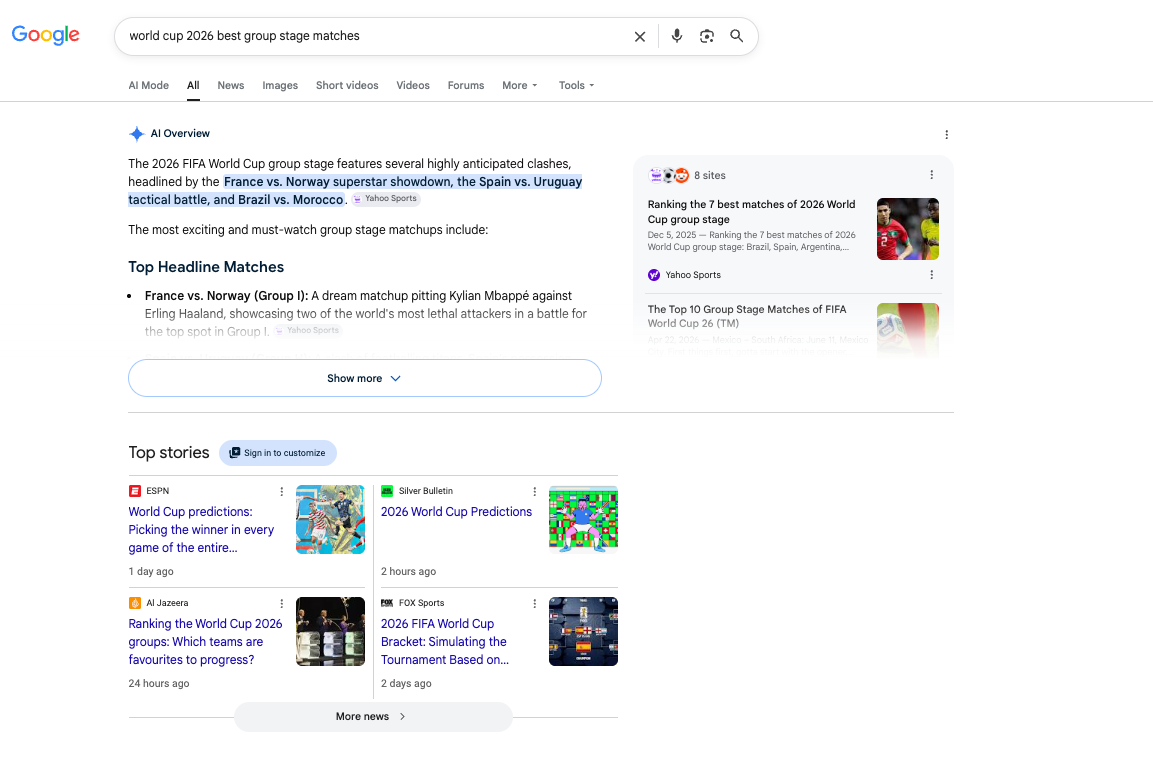
So the strategy splits cleanly. Evergreen content: optimize to be cited. Live content: optimize to be fast. Stop spending live-content energy on the half AI already won, and stop treating your live advantage as if it needs SEO tricks to survive.
The traffic surface that rewards exactly what you do
If you take one tactical priority from this, make it Google Discover. Discover is now one of the largest traffic-driving surfaces for publishers, in many cases rivaling or beating organic search, and it works in your favor here because it is feed-based, not query-based.
Nobody searches for a goal that has not happened. But Discover surfaces fresh, relevant content to interested users without a query at all, which is precisely the behavior a 39-day tournament produces at scale. The February 2026 Discover core update rewards demonstrated topic-level expertise, original reporting, strong visuals, and freshness, and it now reaches desktop as well as mobile.

For the World Cup that means consistent, high-quality football coverage published fast, with sharp original images and honest headlines rather than clickbait. A publisher that establishes clear topical authority on the tournament and feeds Discover a steady stream of timely, well-made content can pull volumes that dwarf what search alone would deliver. This is the single biggest Google traffic opportunity of the tournament, and it is one AI answers do not stand between you and the reader.
The real-time content engine
Covering 104 matches across 16 cities and multiple time zones will break a desk that works the way desks worked in 2018. The answer is not more people staying up later. It is an engine that does the mechanical work the instant a result lands, so your editors spend their energy on judgment.
Here is the shape of it. The same approach is covered in more depth in our roundup of the best automation workflow tools.
A trigger watches a reliable results feed. The moment a match ends, an automation pulls the final score, key events, and basic stats into a structured brief. An AI step drafts a first-pass reaction in your house voice from a template you control: headline options, a short lead, the three talking points that matter, and the obvious follow-up angle. That draft lands in your CMS as a pending post within seconds.
Then a human takes over. An editor reads it, sharpens the take, adds the thing only a person watching the match would know, and hits publish. You compress a 20-minute scramble into a two-minute edit, and you do it for every match without burning out the team. This is the same family of build behind how AI agents are transforming content marketing: agents handle the repeatable scaffolding, humans own the meaning.
That is the entire edge. Not replacing journalists with AI. Removing the lag between the whistle and the published take, so your reaction is live while the moment is.
The caveat that matters most in sport
In sports, speed without accuracy is fatal. Fans catch errors in seconds and screenshot them forever. A wrong scorer, a misattributed assist, a stat that does not match what 80,000 people just watched, and your credibility takes a hit that no amount of speed earns back.
So the human stays in the loop, always. The automation drafts; it does not publish. Anything the system cannot verify against a trusted feed gets flagged, not guessed. The goal is to make your real people faster, not to take them out. The publications that win this will be the ones that move fast and are right, in that order.
Your pre-tournament checklist
The tournament starts June 11. The work to set this up needs to happen before then, not during.
Pick one reliable results and stats feed and confirm its latency. Build and test your reaction template in your own voice, with the angles you actually use. Wire the trigger-to-draft flow into your CMS and run it against a few finished matches as a dry run. Audit your evergreen World Cup content for citation readiness: clear facts, clean structure, accurate data. Decide your editorial line on what publishes automatically (nothing) versus what an editor approves (everything). Assign who is on the desk for which time-zone windows, because North American kickoffs will land at awkward hours for much of your audience.
Do this now and the tournament becomes the proof point for your whole operation. Live sport is the content AI search cannot take from you. The World Cup is where you show it.